
Iron is From the Sky.
The chemical composition of our planet often leads to the assumption that its elements are “native” or “terrestrial” in origin. However, rigorous astrophysical and geochemical analysis confirms a startling reality: Iron (Fe) is not a product of Earth.2 It is an extraterrestrial visitor, forged in the hearts of distant stars and delivered to our world through cosmic events of unimaginable scale.3
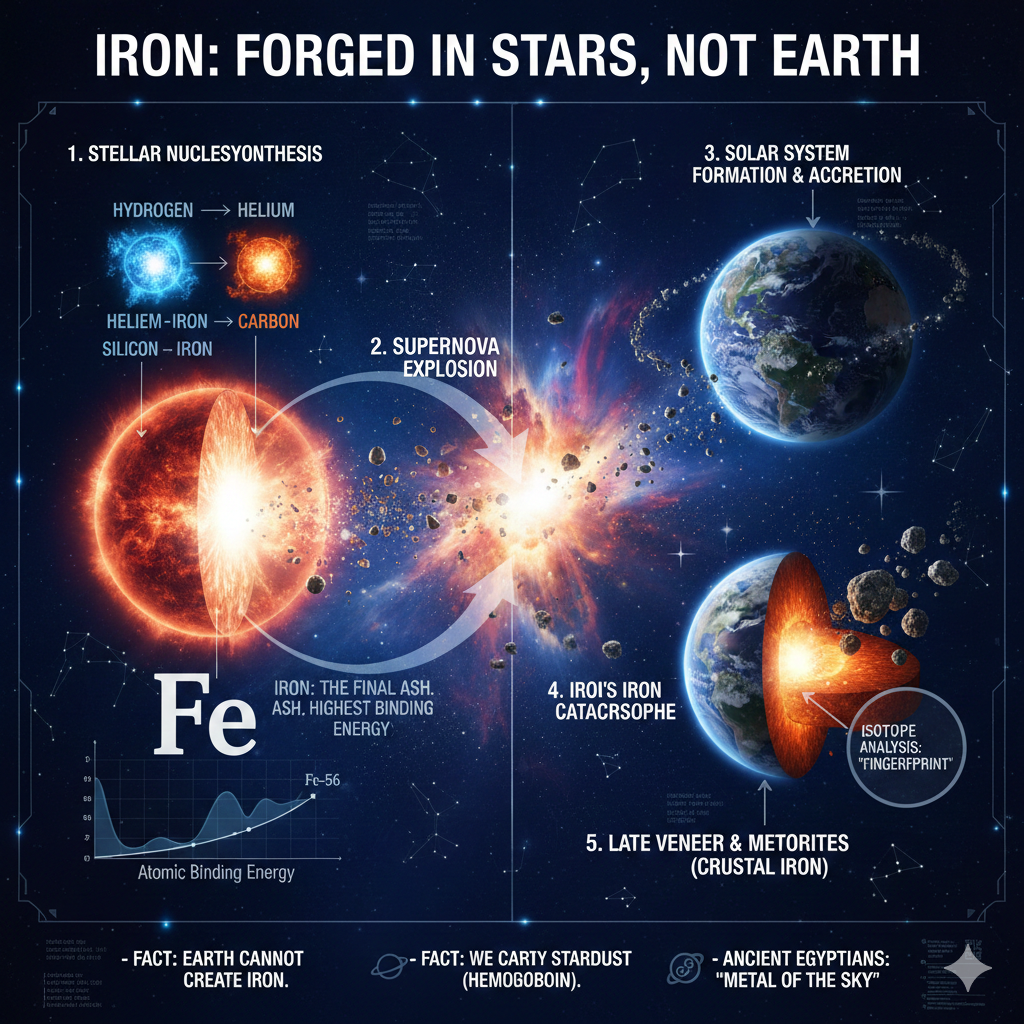
While Earth’s core is predominantly iron, the planet itself lacked the nuclear conditions required to create a single atom of the element. Every gram of iron found in your blood, your car, or the Earth’s crust was literally “sent down” from the sky.4
1. The Stellar Forge: Nucleosynthesis
The primary reason iron is not “from Earth” is the binding energy of the atomic nucleus.5 Earth is a geologically active planet, but its internal temperatures (approx. 6,000°C at the core) and pressures are billions of times too low to facilitate nuclear fusion.
Iron is the “ash” of stellar evolution. In massive stars, fusion proceeds through a chain:6
- Hydrogen —> Helium
- Helium –> Carbon8
- …ultimately leading to Silicon –> Iron.
The Iron Dead-End
Iron represents the most stable nuclear configuration. Fusing elements lighter than iron releases energy (exothermic), but fusing iron requires an input of energy (endothermic).9 Consequently, once a star’s core turns to iron, it can no longer support itself against gravity.
“Iron is the final product of stellar nucleosynthesis… it is the ‘nuclear graveyard.’ Beyond iron, a star cannot produce energy to sustain its own weight.” [^1]
2. Delivery Mechanisms: Supernovae and Meteorites10
If iron is trapped in the cores of stars, how did it reach Earth? The answer lies in the violent death of stars and the subsequent formation of the solar system.
Type Ia and Type II Supernovae
When massive stars exhaust their fuel, they collapse and explode as Supernovae.11 These explosions scatter iron and other heavy elements across the vacuum of space.12
- Type II Supernovae: Responsible for about 1/3 of the iron in our galaxy. [^2]
- Type Ia Supernovae: The primary “iron factories,” contributing nearly 2/3 of the galactic iron supply. [^3]
Accretion and The “Iron Catastrophe”
During the formation of the Solar System 4.56 billion years ago, Earth accreted from a cloud of gas and dust enriched by these previous supernovae.13 In its molten state, Earth underwent a process called differentiation or the “Iron Catastrophe.” Due to its high density, the majority of the iron sank to the center, forming the core, while only trace amounts remained in the crust.14
3. Comparative Abundance and Key Facts
The following table illustrates the distribution of iron, highlighting its prevalence despite its external origin.
Distribution of Iron in the Geosphere
| Region | Iron Content (%) | Origin / Delivery Status |
| Inner Core | ~80–85% | Primary Accretion (Stardust) |
| Outer Core | ~85–90% | Primary Accretion (Stardust) |
| Mantle | ~5.8% | Distributed during differentiation |
| Crust | ~5.0% | Late Veneer / Meteoritic Delivery |
Key Scientific Facts
- Atomic Stability: Iron (56Fe) has the highest binding energy per nucleon of any element, making it the terminal point of fusion.16
- The Late Veneer: Much of the iron accessible in the Earth’s crust today was delivered by a “Late Veneer” of meteorites after the Earth’s core had already formed.17 [^4]
- Ancient Recognition: Ancient Egyptians referred to iron as bjꜣ-n-p.t, which literally translates to “metal of the sky.” [^5]18
4. Geochemical Signatures
We know iron is from space because of Isotope Analysis. By comparing the ratios of iron isotopes (54Fe, 56Fe, 57Fe, 58Fe) found on Earth with those found in Chondritic meteorites, scientists have confirmed that Earth’s chemical “DNA” matches the debris of the early solar nebula. [^6]
No scriptures mention about the origin of Iron except The Quran. The Quran contains a specific and famous verse regarding the origin of iron. It is found in Chapter 57 (Surah Al-Hadid), which is aptly titled “The Iron.”
The Key Verse: Surah Al-Hadid (57:25)
In this verse, the Quran states:
“…And We sent down iron, in which is great might, as well as many benefits for mankind…” [^7]
Scientific and Linguistic Explanation
The term used in Arabic is “Anzalna” (أَنزَلْنَا), which literally translates to “We sent down.” This phrasing is significant for several reasons:
- Extraterrestrial Origin: Historically, scholars interpreted “sent down” metaphorically, as in “bestowed as a gift.” However, modern astrophysics has revealed that iron could not have formed on Earth. It requires the immense heat and pressure of a Supernova (exploding star) to be forged. It literally fell to Earth from space during the planet’s formation.
- The Verb Choice: For other resources like water or vegetation, the Quran often uses terms like “brought forth” or “made.” Using “sent down” specifically for iron—a metal that science now confirms is a cosmic “immigrant”—is considered by many to be a scientific miracle.
- Numerical Significance:
- Atomic Number: If you count the verses in Surah Al-Hadid including the opening “Bismillah,” the word “Iron” appears in the 26th verse. 26 is the atomic number of iron.
- Isotope and Chapter: The chemical symbol for iron is $Fe$, and its most common stable isotope is $^{56}Fe$ or $^{57}Fe$. Surah Al-Hadid is the 57th chapter of the Quran.
- Gematrical Value: In the Arabic Abjad system (where letters have numerical values), the word “Al-Hadid” (The Iron) has a value of 57, matching the chapter number. The word “Hadid” (Iron) without the definite article has a value of 26, matching the atomic number. [^8]
Comparison with Other Scriptures
While other ancient religious texts (such as the Bible or the Torah) mention iron in the context of tools, weapons, or as a symbol of strength (e.g., the “Iron Age” contexts), they generally treat it as a terrestrial resource found in the ground or mountains. The specific description of iron being “sent down” from the heavens is a unique characteristic of the Quranic text.
Key Summary Table
| Feature | Quranic Context (Surah 57:25) | Modern Scientific Fact |
| Origin | “Sent down” (Anzalna) | Forged in Supernovae; delivered via meteorites. |
| Utility | “Many benefits for mankind” | Critical for technology, infrastructure, and biology (Hemoglobin). |
| Strength | “In it is great might” | Highest binding energy; most stable nucleus. |
| Math | Word value/Verse count: 26 & 57 | Atomic number: 26; Isotope weight: 57. |
Would you like me to analyze the historical context of when this verse was revealed compared to the development of early metallurgy?
Summary of Scientific Findings
- No Terrestrial Synthesis: Earth cannot create iron; it only collects it.
- Cosmic Travel: Every iron atom traveled light-years across the interstellar medium before being trapped by Earth’s gravity.
- Biological Necessity: Life as we know it is powered by this celestial metal; hemoglobin requires iron to transport oxygen, meaning we carry “stardust” in our veins.19
Footnotes
[^1]: Clayton, D. D. (2003). Handbook of Isotopes in the Cosmos. Cambridge University Press.
[^2]: Woosley, S. E., & Weaver, T. A. (1995). “The Evolution and Explosion of Massive Stars. II. Explosive Nucleosynthesis and Radiative Spectra.” The Astrophysical Journal Supplement Series.
[^3]: Nomoto, K., et al. (1997). “Nucleosynthesis in Type Ia Supernovae.” Nuclear Physics A.
[^4]: Bottke, W. F., et al. (2010). “Stochastic Late Accretion to Earth, Mars, and the Moon.” Science.
[^5]: Johnson, D., et al. (2013). “Analysis of a Prehistoric Egyptian Iron Bead with Implications for the Use of Meteoritic Iron.” Meteoritics & Planetary Science.
[^6]: Dauphas, N. (2017). “The Isotopic Nature of the Earth’s Accreting Material.” Nature.
[^7]: Quran, Surah Al-Hadid 57:25.
[^8]: Ghernaout, D. (2017). “The Holy Koran Revelation: Iron Is a ‘Sent Down’ Metal.” American Journal of Environmental Protection.
Do you know that atmosphere has very important role to protect earth. Read more on this article. Bookmark accuratiq.com for further interesting facts about universe.