
The Earth’s atmosphere serves as a multi-layered protective shield, regulating surface temperature and filtering hazardous extraterrestrial threats. This deep analysis examines its primary mechanisms: thermal regulation, radiation shielding, and physical protection.
1. Thermal Regulation: The Greenhouse Blanket
The atmosphere acts as a “natural climate regulator,” maintaining Earth’s surface temperature within an inhabitable range (Li et al., 2009). Without it, the global mean temperature would drop to approximately −18 °C (Li et al., 2009).
- Atmospheric Pressure: Total atmospheric pressure (largely from Nitrogen and Oxygen) regulates the greenhouse effect by “broadening” the infrared absorption lines of greenhouse gases (Li et al., 2009). Higher pressure increases the efficiency of heat trapping.
- Greenhouse Gases: Water vapor and CO2 serve as a “blanket” to trap heat emitted from the surface (Li et al., 2009). CO2 is Earth’s most critical long-lived greenhouse gas; while it makes up a small fraction of the atmosphere, it prevents the planet from freezing (National Oceanic and Atmospheric Administration [NOAA], n.d.).
2. Radiation Shielding: The Stratospheric Umbrella
The atmosphere protects the biosphere from the Sun’s most lethal energy through absorption and reflection.
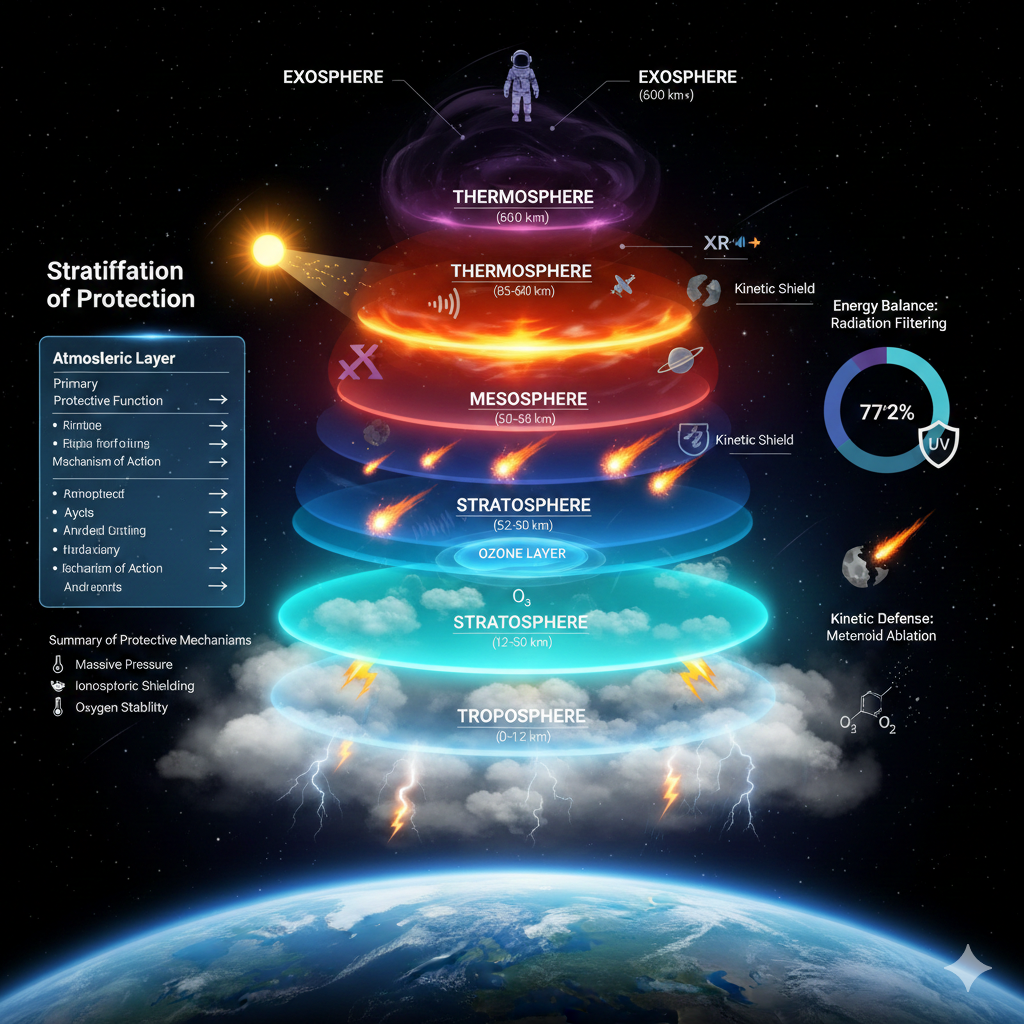
- The Ozone Layer: Located in the stratosphere (roughly 10–50 km above the surface), the ozone layer acts as a “crucial umbrella” that absorbs the majority of the Sun’s harmful ultraviolet (UV) radiation (Green et al., 1999). Without this shield, terrestrial life would be impossible (Green et al., 1999).
- Albedo and Scattering: Particles and clouds in the atmosphere absorb or reflect approximately 23% of incoming solar radiation, preventing it from reaching the surface (Schlesinger et al., 2020).
3. Physical Protection: Meteoroid Ablation
The atmosphere serves as a physical barrier against high-velocity interplanetary debris.
- Ablation and Friction: As meteoroids enter the upper atmosphere (specifically the mesosphere, 80–105 km), they undergo “ablation”—a process where friction with atmospheric gases converts their kinetic energy into heat, vaporizing the objects (Plane et al., 2015).
- Meteoric Smoke: Most small meteoroids are entirely consumed, leaving behind “meteoric smoke particles” that eventually settle on the Earth’s surface after several years (Plane et al., 2015).
References
- Green, B., et al. (1999). Advancing our understanding of the atmosphere and ionosphere using remote sensing techniques. Johns Hopkins APL Technical Digest, 20(4). https://www.jhuapl.edu/Content/techdigest/pdf/V20-N04/20-04-Green.pdf
- Li, K.-F., Pahlevan, K., Kirschvink, J. L., & Yung, Y. L. (2009). Atmospheric pressure as a natural climate regulator for a terrestrial planet with a biosphere. Proceedings of the National Academy of Sciences, 106(24), 9576–9579. https://doi.org/10.1073/pnas.0809436106
- Plane, J. M. C., Feng, W., & Dawkins, E. C. M. (2015). The mesosphere and metals: Chemistry and changes. Chemical Reviews, 115(10), 4497–4541. https://doi.org/10.1021/cr500501m
Read other article : Iron is not from Earth but from the Sky. And The Universe is Expanding. Do not forget to bookmark Accuratiq.com.