
The Barrier Between Salt and Fresh Water: Fluid Dynamics and Estuarine Physics
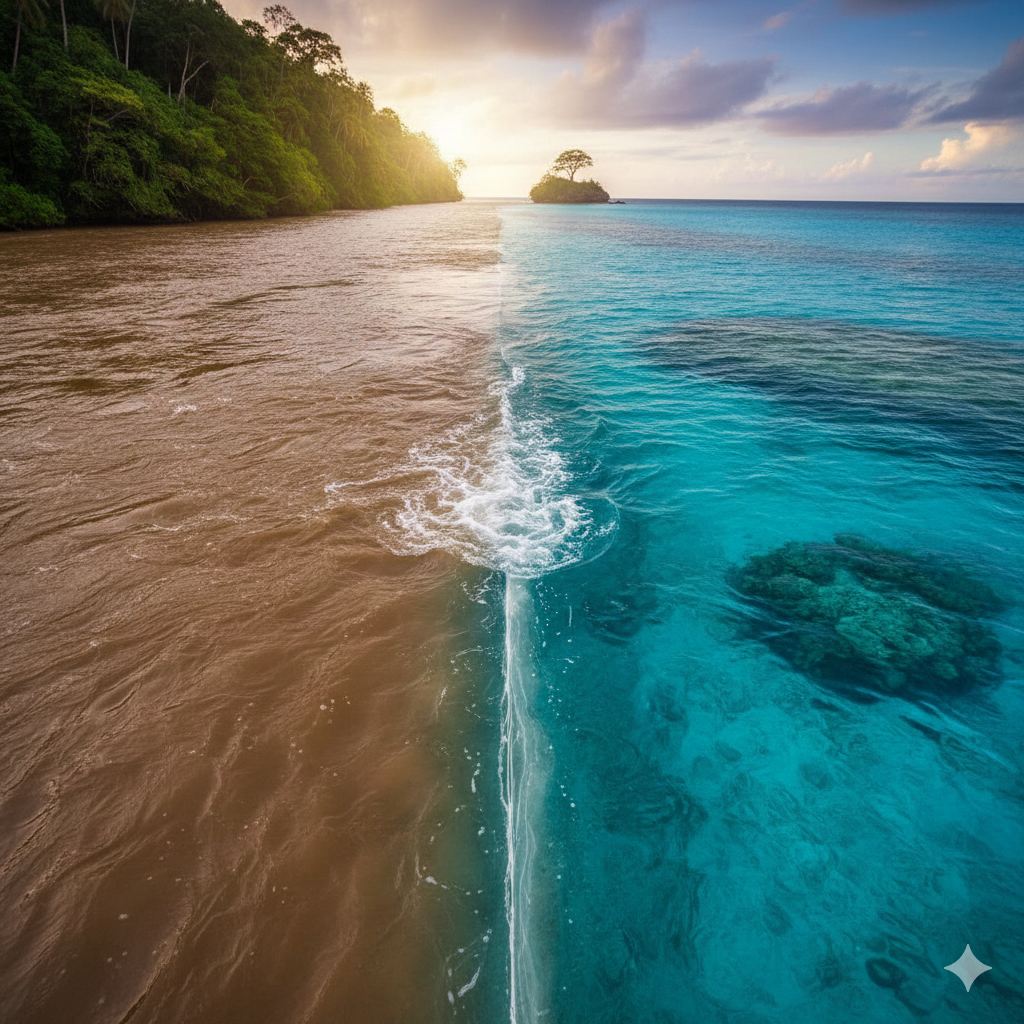
The meeting of fresh water and salt water is one of the most dynamic and ecologically significant interfaces on Earth. While it may appear as a simple mixing zone, the transition between these two fluid bodies is governed by complex laws of fluid mechanics, thermodynamics, and hydrology. In many coastal environments, particularly estuaries, these waters do not mix immediately or uniformly.1 Instead, they form a “barrier”—a transition zone characterized by sharp gradients in density, salinity, and temperature.2
1. The Physics of Density and Stratification
At the heart of the barrier between fresh and salt water lies the concept of density.3 Pure water at room temperature has a density of approximately $1.000\text{ g/cm}^3$. In contrast, seawater contains dissolved salts—primarily sodium chloride—which increase its density to roughly $1.025\text{ g/cm}^3$.
When a river (fresh water) meets the ocean (salt water), the lighter fresh water tends to float atop the heavier, denser salt water.4 This creates a vertical stacking known as stratification. The region where the salinity changes most rapidly with depth is called the halocline.5
2. Types of Estuarine Barriers
The “barrier” is not a static wall but a functional zone of separation. Oceanographers classify these interactions based on how the waters circulate and the degree of mixing that occurs:6
- Salt-Wedge Estuaries: These occur when a powerful river enters a sea with low tidal range.7 The fresh water rushes over the salt water, pushing it down. This creates a sharp, wedge-shaped boundary where the two fluids remain remarkably distinct.8
- Fjord-type Estuaries: In deep glacial valleys, a shallow “sill” or underwater ridge acts as a physical barrier at the mouth of the fjord.9 This sill restricts the entry of dense seawater, trapping a layer of stagnant, high-salinity water at the bottom while fresh water flows freely above it.10
- Partially Mixed Estuaries: In areas with moderate tidal action, the “barrier” becomes a blurred zone of brackish water. However, a distinct density gradient remains, preventing total homogenization.
Key Factors Influencing the Barrier
| Factor | Effect on Mixing |
| River Flow Rate | Higher flow increases stratification and maintains a sharper barrier. |
| Tidal Range | Strong tides act as a mechanical “stirrer,” breaking down the barrier. |
| Coriolis Effect | In large estuaries, the Earth’s rotation can tilt the barrier, pushing fresh water to one side. |
| Bathymetry | The shape of the seafloor (e.g., sills) can physically trap salt water. |
3. The Pycnocline: A Functional Partition
Beyond simple salinity, the barrier is often a pycnocline—a layer where water density changes rapidly.11 This zone acts as a physical partition that affects the transport of nutrients, oxygen, and even microplastics.[^1]12
Because the pycnocline limits vertical mixing, it creates a unique ecological “ecotone.” Organisms living in these transition zones must be euryhaline, meaning they can survive wide swings in salinity. The barrier also serves as a filter, trapping sediments and terrestrial pollutants before they can reach the open ocean.[^2]
4. Quranic Perspective on the Aquatic Barrier
The phenomenon of a “partition” between fresh and salt water is a subject of significant reflection in the Quran.13 Several verses describe the meeting of two bodies of water that do not transgress their boundaries.14
The “Prohibiting Partition”
In Surah Al-Furqan (25:53), the Quran provides a specific description:
“And it is He who has released [simultaneously] the two seas, one fresh and sweet and one salty and bitter, and He placed between them a barrier and prohibiting partition.”
Similarly, in Surah Ar-Rahman (55:19-20):
“He released the two seas, meeting [side by side]; between them is a barrier [so] neither of them transgresses.”
Scientific and Linguistic Analysis
Islamic scholars and modern researchers have noted the precision of the Arabic terminology used:
- Barzakh (Barrier): This term refers to a partition or an “unseen” separation.15 In oceanography, the halocline is exactly this—a physical reality that is often invisible to the naked eye but acts as a functional wall between two different fluid masses.16
- Hijran Mahjura (Prohibiting Partition): When describing the meeting of fresh and salt water (as in estuaries), the Quran adds the phrase “prohibiting partition.”17 Modern interpretations suggest this refers to the pycnocline zone, which has its own unique chemical properties and serves as a transition area where the two waters lose their original characteristics and become homogenized.[^5]
Early commentators were often puzzled by how two bodies of water could “meet” (as the term maraja suggests) and yet have a “barrier” that they “do not transgress.”18 Today, the study of estuarine fluid dynamics provides a clear answer: while the water molecules themselves may eventually cross the barrier, the identity and integrity of the two distinct bodies of water are maintained by the density-driven interface.[^6]19
Footnotes
[^1]: MDPI Water Journal. Halocline Induced by Rainfall in Saline Water Ponds.
[^2]: Wikipedia. Pycnocline and its role in ocean stratification.
[^3]: NOAA’s National Ocean Service. Classifying Estuaries: By Water Circulation.
[^4]: Savenije, H. H. G. (2005).20 Salinity and Tides in Alluvial Estuaries. Elsevier.
[^5]: Alukah. The Barrier Between Sweet and Salt Waters.
[^6]: Moore, K. L. (1986). Human Development as Revealed in the Quran and Hadith.
[^7]: Dr. William Hay, Professor of Geological Sciences, University of Colorado, on the observation of water mass integrity.