
The Moon’s Phases Compared to an Old Date Stalk
The visual progression of the lunar cycle has been a cornerstone of timekeeping and spiritual reflection across various civilizations for millennia. One of the most striking metaphors for this cycle—found in ancient literature and corroborated by modern celestial mechanics—is the comparison of the moon’s waning crescent phase to an “old date stalk” (the urjun al-qadim).
This article explores the astronomical accuracy of this analogy and the physical properties that make it a scientifically apt description.
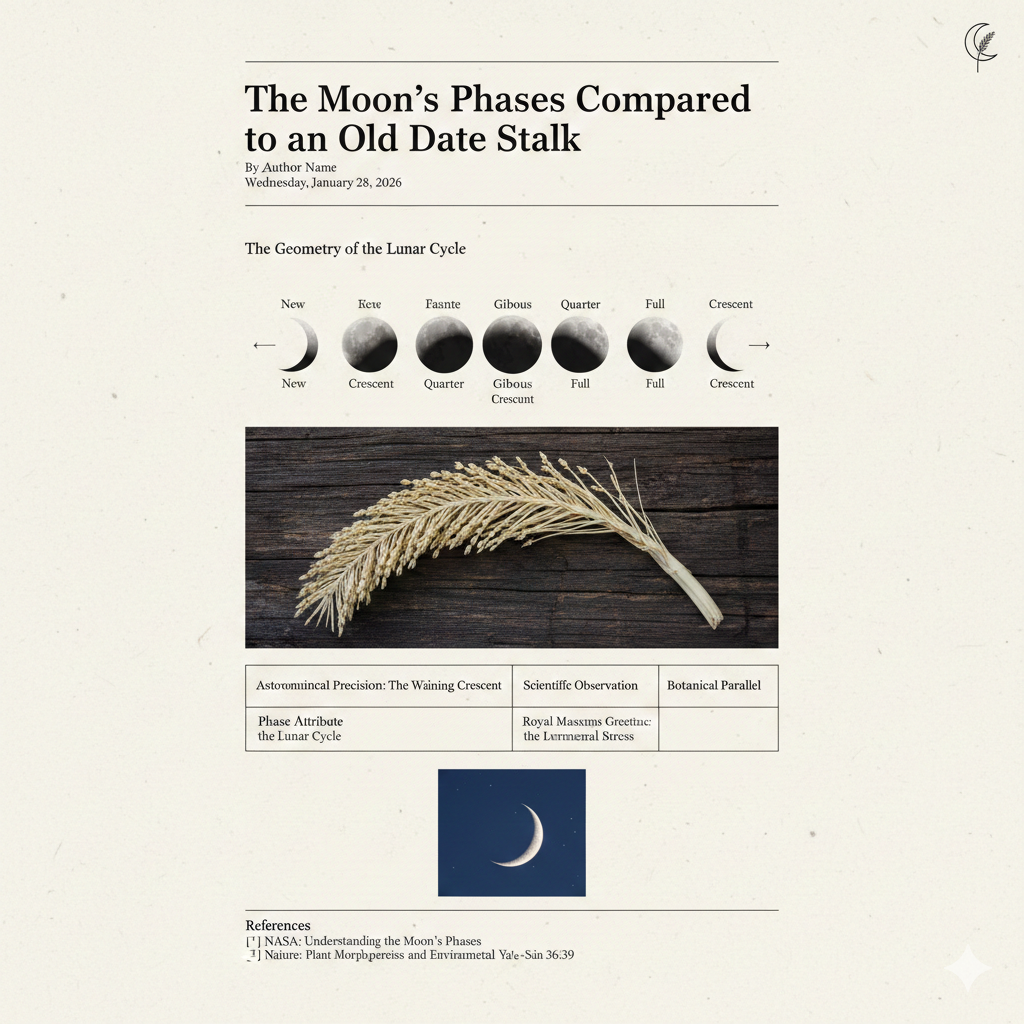
The Geometry of the Lunar Cycle
The lunar cycle, or synodic month, lasts approximately 29.53 days. As the Moon orbits the Earth, the angle of sunlight hitting its surface changes from our perspective, creating the phases we observe.
While the “Full Moon” often receives the most attention, the final stages of the waning crescent provide a unique geometric profile. As the Moon approaches the sun in the sky, the visible illuminated sliver narrows and begins to curve significantly toward the solar disk.
The “Old Date Stalk” Analogy
The comparison refers specifically to the raceme of a date palm. After the fruit is harvested or falls off, the stalk (the urjun) dries out, undergoes lignification, and loses its moisture. This process causes the stalk to:
- Curve under its own structural stress.
- Thin out as it dehydrates.
- Turn a pale, yellowish-white, remarkably similar to the color of the Moon against a morning sky.
Astronomical Precision: The Waning Crescent
In the final days of the lunar month (the 26th through the 28th day), the Moon appears as a “waning crescent.” At this stage, it is visible in the eastern sky just before sunrise.
| Phase Attribute | Scientific Observation | Botanical Parallel |
| Curvature | High eccentricity due to the extreme angle of the Sun. | The natural arc of a dried, weighted palm branch. |
| Thickness | Minimal “lune” width; often only a few degrees of arc. | The slender profile of a spent fruit stalk. |
| Color/Albedo | Low-angle sunlight creates a “sallow” or pale ivory hue. | The bleached, pale-yellow appearance of aged organic fibers. |
Celestial Mechanics and Visual Perception
The “old” nature of the stalk is the key to the scientific accuracy of the metaphor. A fresh date stalk is green, straight, and thick. Only an “old” stalk possesses the characteristic curvature and paleness required to mimic the Moon’s appearance just before it vanishes into the “New Moon” phase (conjunction).
From an observational standpoint, the urjun metaphor captures the three-dimensional reality of the Moon’s orbit. Because the Moon’s orbit is not a perfect circle but an ellipse (e = approx 0.0549), its apparent speed and thickness vary slightly, much like the irregular tapering of a natural plant stalk.
Conclusion
The comparison between the lunar phases and an old date stalk is more than a poetic device; it is a sophisticated observation of botanical and celestial morphology. It highlights the transition from the “fullness” of the month to a state of skeletal thinness before the cycle begins anew. The Moon’s Phases Compared to an Old Date Stalk is already mentioned in Quran. Chapter 36. Verse 39. “And the moon – We have measured for it phases until it returns like the old stalk of a date palm”
References
[^1]: NASA: Understanding the Moon’s Phases
[^2]: Royal Museums Greenwich: The Lunar Cycle
[^3]: Nature: Plant Morphogenesis and Environmental Stress (On the curvature of aging plant stalks)
[^4]: The Quran, Surah Ya-Sin 36:39 (Primary historical source for the “Urjun” metaphor)