

Plant Pairs: Dioecy and the Evolution of Sexual Dimorphism
In the botanical world, “pairing” often refers to the spatial and ecological relationship between separate male and female individuals. While approximately 90% of flowering plants are hermaphroditic (containing both sexes in one flower), a specialized 5–6% of angiosperms and the majority of gymnosperms are dioecious. This means “two houses”: one plant produces only male flowers (staminate), and another produces only female flowers (pistillate).
The “pair” in this context is a fundamental reproductive unit required for the survival of the species, often resulting in fascinating examples of sexual dimorphism and co-evolutionary strategies.
1. The Biological Necessity of the Pair
Dioecy evolved as a primary mechanism to prevent self-fertilization (inbreeding). By separating the sexes onto different plants, species ensure maximum genetic diversity. However, this creates a biological challenge: the “pair” must be synchronized in time and space.
- Synchrony: Male and female plants must flower simultaneously, often triggered by identical photoperiods or temperature thresholds.
- Proximity: Pollinators or wind must be able to bridge the gap between the male pollen donor and the female seed producer.
2. Notable Examples of Dioecious “Plant Pairs”
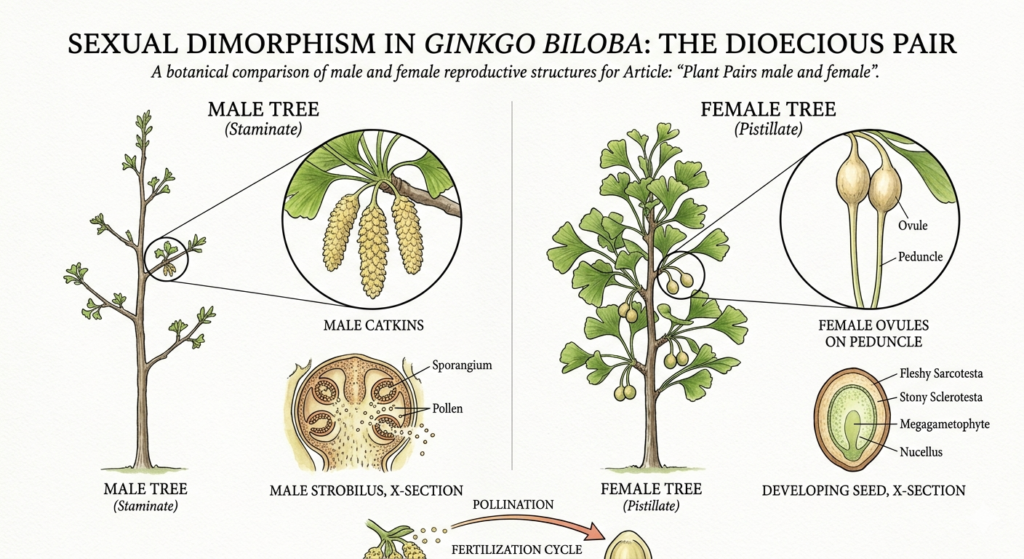
A. The Ginkgo Tree (Ginkgo biloba)
Perhaps the most famous “living fossil” pair, the Ginkgo is strictly dioecious.
- The Male: Produces small, cone-like catkins that release pollen into the wind.
- The Female: Produces ovules in pairs on short stalks. Once pollinated, they develop into fleshy, fruit-like seeds known for their potent butyric acid scent.
- In Urban Planning: Most city trees are “paired” in nurseries to select only males to avoid the messy, odorous seeds produced by the females.
B. The Kiwifruit (Actinidia deliciosa)
In agriculture, the “pairing” of Kiwi plants is a precise science.
- The Ratio: Commercial orchards typically plant a “pair” in a specific ratio—often one male plant for every eight female plants—to ensure adequate pollination for fruit set.
- Dimorphism: Female flowers have large, functional ovaries and sterile anthers, while male flowers produce massive amounts of viable pollen but lack reproductive ovaries.
C. Sea Buckthorn (Hippophae rhamnoides)
This hardy shrub is a classic example of wind-pollinated dioecy.
- The Male: Features brownish flower buds that produce clouds of pollen.
- The Female: Produces the bright orange, nutrient-dense berries. Without a male “partner” within a 10–15 meter radius, the female plant remains barren.
3. Comparison of Sexual Dimorphism in Plant Pairs
| Species | Primary Pollinator | Male Characteristics | Female Characteristics |
| Date Palm | Wind/Manual | Large inflorescences; high pollen count. | Fruiting clusters; requires specific male pairing. |
| Holly (Ilex) | Insects (Bees) | Small, nectar-rich flowers; no berries. | Produces iconic red drupes (berries). |
| Cannabis | Wind | Tall, slender; produces pollen sacs. | Dense floral bracts; produces resin/seeds. |
| Willow (Salix) | Wind/Insects | Yellow, pollen-heavy catkins. | Greenish catkins; produces “fluff” (seeds). |
4. Evolutionary Trade-offs: The “Cost of Sex”
Research suggests that female plants often invest significantly more energy into reproduction (producing fruits and seeds) than their male counterparts. This often leads to visible differences in the pair’s growth patterns:
- Niche Partitioning: In some species, male plants are found in drier, more stressful environments, while females occupy nutrient-rich soil to support the “cost” of seed production.
- Defense Mechanisms: Female plants in some species (like Baccharis) produce higher levels of secondary metabolites (toxins) to protect their developing seeds from herbivores.
“Dioecy has evolved independently in hundreds of plant families, representing a convergent solution to the problem of inbreeding depression.” — Philosophical Transactions of the Royal Society B
The fact that plants is created in pairs, already mentionen in Quran. Chapter 36. Verse 36. “Glory be to Him (Allah) who created all pairs from what the earth grows…”
References & Footnotes
- Renner, S. S. (2014). “The Relative Humidity of Sex: The Evolution of Dioecy in Flowering Plants.” Evolutionary Biology. Link via Springer
- Barrett, S. C. H. (2002). “The Evolution of Plant Sexual Diversity.” Nature Reviews Genetics. Link to Nature
- Ginkgo Pages. “The Sexuality of Ginkgo biloba.” Botanical Analysis
- Korpelainen, H. (1998). “Sex ratio strategies and genetic variation in dioecious plants.” The Botanical Review. [suspicious link removed]
- USDA. “Dioecious Plants in Forest Ecosystems.” Forest Service Research