

Embryonic Development in Stages: A Scientific and Scriptural Overview
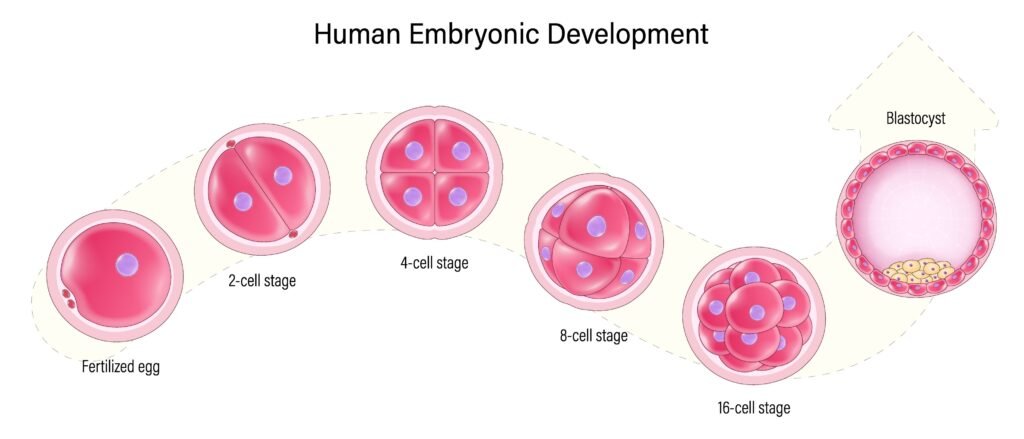
The journey from a single fertilized cell to a complex, multi-billion-cell human being is one of the most sophisticated processes in biological science. This article provides a comprehensive examination of human embryology through the lens of modern developmental biology, while also exploring the historical and theological parallels found in the Quranic descriptions of human creation.
1. The Pre-Embryonic Stage: Conception and Germinal Period
Human development begins at fertilization, the moment a male sperm fuses with a female oocyte (egg) to form a zygote.1 This occurs typically in the ampulla of the uterine tube.
Fertilization and the Zygote
The zygote contains a unique genetic blueprint, consisting of 46 chromosomes (23 from each parent).2 This single cell is “totipotent,” meaning it has the potential to produce any cell type in the human body.
Cleavage and Blastocyst Formation
Within 24 to 30 hours, the zygote undergoes mitotic division, a process known as cleavage.3 As the cells divide, they form a solid ball called a morula (Latin for “mulberry”).4
By day 4 or 5, fluid enters the morula, creating a central cavity.5 This stage is known as the blastocyst. It consists of two primary components:
- The Inner Cell Mass (Embryoblast): Which will become the embryo.
- The Trophoblast: Which will form the placenta and supporting membranes.6
Implantation
Around day 6, the blastocyst begins to embed itself into the uterine lining (endometrium). This is a critical window for a successful pregnancy, requiring precise hormonal synchronization between the embryo and the mother.7
2. The Embryonic Period (Weeks 3–8)8
The embryonic period is characterized by organogenesis—the formation of the body’s organs and systems.9 This is the period when the developing human is most vulnerable to teratogens (factors that cause birth defects).
Gastrulation: The Third Week
Gastrulation is often described as the most important event in life.10 The bilaminar embryonic disc transforms into a trilaminar disc, consisting of three primary germ layers:11
- Ectoderm: Becomes the nervous system and skin.12
- Mesoderm: Becomes muscles, bones, circulatory system, and kidneys.13
- Endoderm: Becomes the lining of the digestive and respiratory tracts.14
Neurulation and Heart Development (Weeks 4–5)
By the fourth week, the neural tube (the precursor to the brain and spinal cord) closes.15 Simultaneously, the heart begins to beat, making it the first functioning organ. At this stage, the embryo is C-shaped, with visible “branchial arches” and a prominent tail-like structure that later recedes.
Limb and Facial Development (Weeks 6–8)
During these weeks, limb buds appear and differentiate into fingers and toes (initially webbed). The face begins to take shape as the eyes, ears, and nose move into their final positions.16 By the end of the eighth week, the embryo has a distinctly human appearance.
3. The Fetal Period (Week 9 to Birth)
From the ninth week until birth, the developing organism is called a fetus.17 This stage focuses on the maturation of tissues and the rapid growth of the body.
- Weeks 9–12: The head constitutes half the size of the fetus.18 Primary ossification (bone formation) begins.
- Weeks 13–16: Rapid growth occurs; the fetus makes coordinated movements that the mother may begin to feel (quickening).
- Weeks 21–25: Surfactant is produced in the lungs, a substance necessary for breathing after birth. The fetus reaches the “threshold of viability.”
- Weeks 26–38: Fat deposits build up, the nervous system matures enough to regulate body temperature, and the fetus prepares for the transition to the outside world.19
4. The Quranic Perspective on Embryology
For centuries, scholars have noted the striking similarities between the stages of development described in the Quran and modern embryological findings.20 The Quran (revealed in the 7th century) uses specific terminology to describe the transformation of the embryo.21
The Stages of Creation
The most famous passage regarding this process is found in Surah Al-Mu’minun (23:12-14):
“And indeed, We created man from a quintessence of clay. Then We placed him as a drop (Nutfah) in a place of rest, firmly fixed. Then We made the drop into a clinging clot (Alaqah), then We made the clot into a lump (Mudghah), then We made out of that lump bones and clothed the bones with flesh; then We developed out of it another creature.22 So blessed be Allah, the Best to create.”
Analysis of Quranic Terms
1. Nutfah (The Drop)
The term Nutfah refers to a small amount of fluid.23 Modern science confirms that out of millions of sperm in an ejaculation, only one “drop” or a single sperm is required for fertilization.24
2. Alaqah (The Clinging Clot)25
The word Alaqah has three meanings in Arabic: (1) a leech, (2) a suspended thing, and (3) a blood clot.
- Leech: Early embryos at day 24–25 bear a physical resemblance to a leech.26 Furthermore, like a leech, the embryo derives nutrients from the mother’s blood.27
- Suspended: This accurately describes the embryo “hanging” or suspended in the uterus via the umbilical cord and placenta.
3. Mudghah (The Chewed Lump)28
Mudghah means a substance that has been chewed.29 If one were to look at an embryo at roughly 28 days, the somites (precursors to the vertebrae) along the back resemble the teeth marks left on a piece of chewed gum or substance.
4. Formation of Bones and Flesh
The Quran states that bones are formed, then “clothed” with flesh (muscles).30 This aligns with the embryological sequence where the mesoderm differentiates into the cartilaginous skeleton before the myogenic (muscle) cells wrap around them.
5. Synthesis: Science and Faith
The correlation between 7th-century scripture and 20th-century ultrasound and microscopic observations has been a subject of intense discussion.
Dr. Keith L. Moore, a world-renowned embryologist and author of The Developing Human, famously stated that the Quranic descriptions could not have been based on the scientific knowledge available at the time of its revelation. He noted that the division of stages provided by the Quran offers a simpler yet highly accurate classification compared to the complex numerical Carnegie stages used by modern scientists.
Conclusion
The study of embryonic development reveals a world of microscopic precision. From the initial Nutfah to the complex Mudghah and eventually the birth of a human being, the biological steps are a testament to the intricate laws of nature. Whether viewed through the lens of a microscope or the verses of the Quran, the process remains one of the most profound mysteries of existence.
References and Footnotes
- Moore, K. L., Persaud, T. V. N., & Torchia, M. G. (2019). The Developing Human: Clinically Oriented Embryology. Elsevier.
- Sadler, T. W. (2018). Langman’s Medical Embryology. Wolters Kluwer.
- The Noble Quran, Surah Al-Mu’minun (23:12-14) and Surah Az-Zumar (39:6).
- National Institutes of Health (NIH). “Stages of Development of the Fetus.” MedlinePlus
- Moore, K. L. “A Scientist’s Interpretation of References to Embryology in the Qur’an.” Journal of the Islamic Medical Association of North America.