
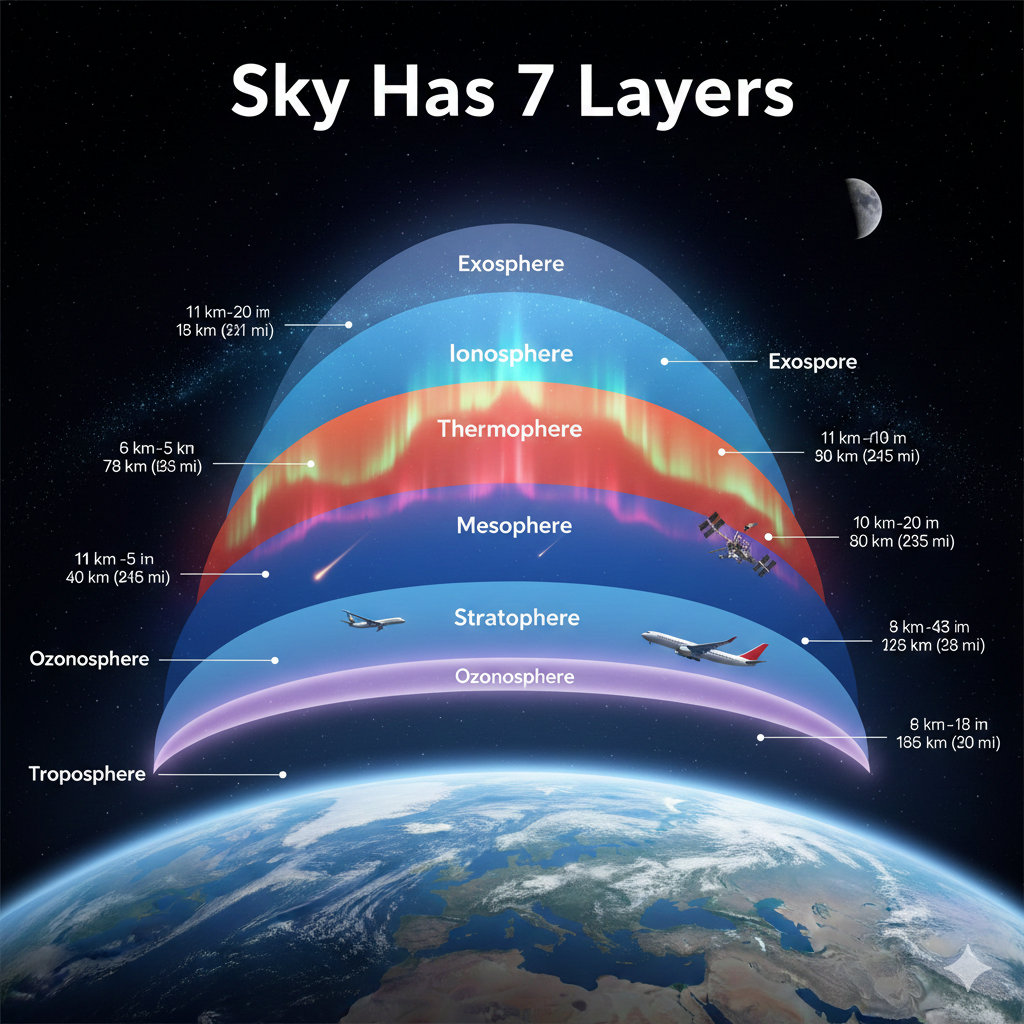

Sky Has 7 Layers: A Scientific and Structural Breakdown
In modern meteorology and atmospheric science, the Earth’s atmosphere is traditionally categorized into five primary layers based on temperature gradients.1 However, when incorporating functional sub-layers and chemical boundaries—such as the Ionosphere and the Ozone Layer—the structure is frequently described as having seven distinct functional regions.
This stratification is essential for protecting life, enabling global communication, and regulating the planet’s temperature.
The Seven Functional Layers of the Sky
1. The Troposphere (0–12 km)2
The lowest layer where we live and breathe.3 It contains roughly 80% of the atmosphere’s mass and 99% of its water vapor.4 Temperature decreases with altitude here, creating the convection that drives our weather.5
- Key Feature: The “Planetary Boundary Layer” (PBL) exists within the bottom 1-2 km, where air movement is directly influenced by the Earth’s surface friction.6
2. The Stratosphere (12–50 km)7
Unlike the troposphere, temperatures rise with altitude in the stratosphere.8 This “temperature inversion” prevents air from mixing vertically, which is why commercial jets fly here to avoid turbulence.9
3. The Ozonosphere (15–35 km)
Often cited as a distinct functional layer within the stratosphere, the Ozone Layer (Ozonosphere) is a region of high 10$O_3$ concentration.11 It acts as the planet’s primary shield, absorbing approximately 97% to 99% of the Sun’s medium-frequency ultraviolet (UV) light.
4. The Mesosphere (50–85 km)12
The “middle” layer and the coldest region of the atmosphere, with temperatures dropping to 13$-90°C$.14
- Meteor Protection: This is the “buffer” where friction causes most meteors to incinerate before reaching the surface.
5. The Thermosphere (85–600 km)15
This layer is characterized by extreme heat, as it absorbs high-energy X-rays and UV radiation.16 However, because the air is so thin, it would not feel “hot” to a human; there are too few molecules to transfer kinetic energy to the skin.
6. The Ionosphere (80–1,000 km)
The Ionosphere is a massive, active layer that overlaps the Mesosphere, Thermosphere, and Exosphere.17 It is a region of particles ionized by solar radiation.18
- Function: It reflects radio waves back to Earth, allowing for long-distance communication, and is the stage for the Aurora Borealis (Northern Lights).19
7. The Exosphere (600 km to 10,000 km)20
The outermost fringe of the atmosphere.21 Here, atoms and molecules are so far apart they can travel hundreds of kilometers without colliding. It eventually thins out into the vacuum of space and the solar wind.
This amazing fact already mentioned in the Quran. Chapter 65. Verse 12 : “It is Allah who created seven heavens and of the earth, the like of them.”
Comparison of Atmospheric Boundaries
| Layer | Type | Altitude | Primary Role |
| Troposphere | Thermal | 0–12 km | Weather and life support |
| Ozonosphere | Chemical | 15–35 km | UV radiation filtering |
| Stratosphere | Thermal | 12–50 km | Atmospheric stability |
| Mesosphere | Thermal | 50–85 km | Meteor shielding |
| Thermosphere | Thermal | 85–600 km | Solar radiation absorption |
| Ionosphere | Electrical | 80–1,000 km | Radio reflection / Auroras |
| Exosphere22 | Density23 | >600 km24 | Transition to outer space25 |
Footnotes & Authoritative Sources
- NASA Space Place: Earth’s Atmosphere: A Multi-layered Cake
- NOAA: Peeling Back the Layers of the Atmosphere
- UCAR Center for Science Education: The Layers of Earth’s Atmosphere
- Royal Belgian Institute for Space Aeronomy: The Ionosphere and Its Sub-regions
Read related article The Origin of the Universe from a Single Point