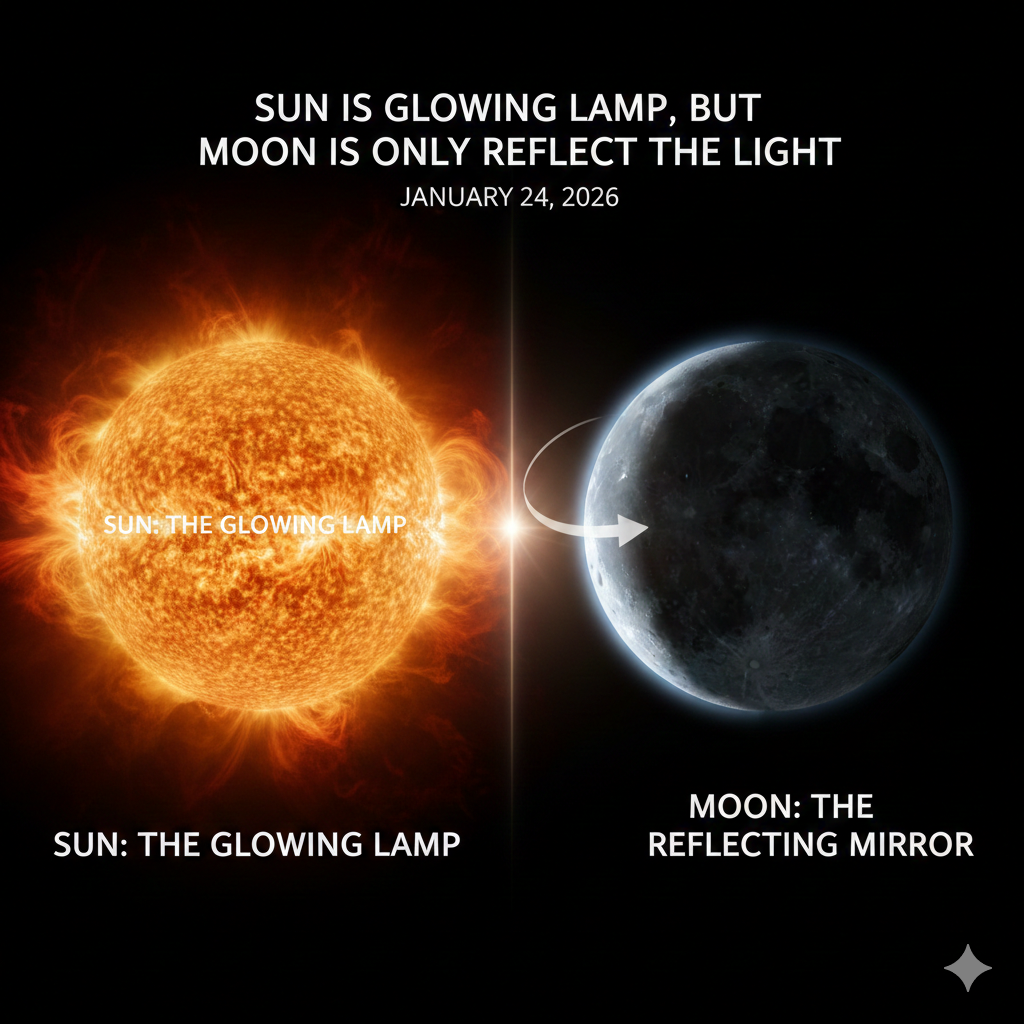

Sun as the Glowing Lamp, Moon only reflect the light.
The relationship between the Sun and the Moon has defined the human perception of time, tides, and divinity for millennia. However, beneath the poetic “silver glow” of the moonlight lies a fundamental astrophysical distinction: one is a self-sustaining nuclear furnace, while the other is a cold, rocky satellite acting as a cosmic reflector.
1. The Sun: The Solar System’s Central Powerhouse
The Sun is not merely a “lamp”; it is a G-type main-sequence star that generates its own light and heat through a process known as nuclear fusion.
The Mechanism of Luminescence
At the Sun’s core, temperatures reach approximately 15 million degrees Celsius. Under this extreme pressure and heat, hydrogen atoms collide and fuse to form helium. This process, specifically the proton-proton chain reaction, converts mass into energy according to Einstein’s famous equation:
E = mc2
This energy travels from the core through the radiative and convective zones, eventually reaching the photosphere—the visible “surface” of the Sun. From here, it is emitted as electromagnetic radiation, including the visible light that illuminates our solar system.
Key Characteristics of Solar Light:
- Total Solar Irradiance (TSI): The Sun provides roughly 1,361 watts per square meter to Earth’s upper atmosphere.
- Spectrum: It emits a continuous spectrum of light, appearing white from space, though our atmosphere scatters shorter wavelengths, making it appear yellow to us.
- Massive Scale: The Sun contains 99.8% of the total mass of the solar system, providing the gravitational “anchor” for all planets.
2. The Moon: A Study in Albedo and Reflection
Unlike the Sun, the Moon is geologically “dead” in terms of light production. It possesses no internal mechanism to generate photons. Instead, the Moon’s visibility depends entirely on Albedo—the measure of how much light a surface reflects.
The Science of Moonlight
Moonlight is actually “second-hand” sunlight. When solar photons strike the lunar surface (the regolith), they are scattered back into space. Only a small fraction of this light reaches Earth.
Interestingly, the Moon is actually a very poor reflector. Its average albedo is approximately 0.12, meaning it reflects only 12% of the light that hits it. To put this in perspective, the Moon is roughly as dark as a fresh asphalt road or a piece of coal. It only appears bright because it is set against the absolute blackness of space.
Comparison: Self-Luminous vs. Reflective
| Feature | The Sun (Luminous) | The Moon (Non-Luminous) |
| Source of Light | Internal Nuclear Fusion | Reflected Sunlight |
| Temperature | ~5,500°C (Surface) | -173°C to 127°C |
| Energy Output | $3.8 \times 10^{26}$ Watts | 0 Watts (Net Generation) |
| Composition | Hydrogen and Helium Plasma | Silicate Rock and Metals |
| Role | Energy Provider | Gravitational/Tidal Influencer |
3. The Geometry of Illumination: Phases and Eclipses
The fact that the Moon only reflects light is most evident in the Lunar Phases. As the Moon orbits the Earth, the angle between the Sun, Moon, and Earth changes. We only see the portion of the Moon’s “day side” that is currently facing us.
The Lunar Cycle
- New Moon: The Moon is between the Earth and Sun; the reflected light is directed away from us.
- Full Moon: The Earth is between the Sun and Moon; we see the entire illuminated hemisphere.
- Quarters: We see a “side-on” view of the light-dark boundary (the terminator).
Visualizing Light Intensity
The chart below illustrates the relative brightness of the Moon compared to the Sun as seen from Earth.
| Celestial Body | Apparent Magnitude (Brightness) | Notes |
| Sun | -26.7 | Blinding; primary source. |
| Full Moon | -12.6 | ~400,000 times fainter than the Sun. |
| Venus | -4.4 | Brightest planet; also reflective. |
4. Earthshine: The Double Reflection
A fascinating phenomenon that proves the Moon is a reflector is Earthshine (or “the Da Vinci Glow”). During a crescent moon, you can often see the faint outline of the “dark” part of the Moon.
This happens because:
- Sunlight hits the Earth.
- Earth reflects that light (Earth has a higher albedo of ~0.30 due to clouds and ice).
- That reflected “Earthlight” hits the Moon.
- The Moon reflects it back to our eyes.
It is a testament to the interconnectedness of light in our local neighborhood.
5. Summary and Conclusion
The Sun is the engine of our solar system, a “glowing lamp” fueled by the most powerful force in physics. The Moon is its silent partner, a stony mirror that regulates our tides and lights our nights without generating a single spark of its own. Understanding this distinction is fundamental to astronomy; it transforms the Moon from a “light” into a “world”—a destination with geography, history, and a deep physical link to the Sun’s radiance. Quran already mentioned about this amazing fact. “And the sun as a shining lamp.” (Quran 78:13). And “And the moon – We have determined it as a light.” (Quran 10:5).
Read also everything is created in pairs
Accuratiq.com Scientific explanation of amazing facts
Footnotes and Authoritative Sources
- NASA – Solar System Exploration: The Sun: https://science.nasa.gov/sun/ ^[1]
- Britannica – Nuclear Fusion in Stars: https://www.britannica.com/science/nuclear-fusion ^[2]
- National Geographic – The Moon’s Albedo: https://www.nationalgeographic.com/science/article/moon-facts ^[3]
- Space.com – How Bright is the Moon?: https://www.space.com/6241-bright-moon.html ^[4]
- Harvard-Smithsonian Center for Astrophysics – Earthshine: https://pweb.cfa.harvard.edu/research/topic/earthshine ^[5]