
The Chemical Transformation of Milk in the Body: A Bio-Physiological Perspective on a Miraculous Natural Process
The production of milk in mammals, a process so eloquently alluded to in the Quran (Surah An-Nahl, Verse 66: “And indeed, for you in the grazing livestock is a lesson. We give you to drink from what is in their bellies—between excretions and blood—pure milk, palatable to drinkers”), represents a profound marvel of biological chemistry. This verse highlights a complex physiological transformation, where nutrients derived from the animal’s ingestion are filtered and synthesized into a pristine, nourishing fluid, distinctly separated from the waste products (excretions) and the circulatory system (blood). This article explores the intricate chemical processes involved in milk synthesis, substantiating the divine wisdom embedded in this ancient text with modern scientific understanding.
The Journey from Ingested Feed to Mammary Gland
The journey of milk begins with the ingestion of feed by the grazing animal. This feed, composed primarily of carbohydrates (cellulose, starches), proteins, fats, vitamins, and minerals, undergoes extensive digestion in the animal’s multi-chambered stomach (in ruminants like cows, sheep, and goats).
- Rumen Fermentation: In the rumen, a diverse microbial population ferments complex carbohydrates into volatile fatty acids (VFAs) such as acetate, propionate, and butyrate. These VFAs are the primary energy source for the animal and crucial precursors for milk fat synthesis [1]. Proteins are also broken down by microbes into amino acids, which are then either re-synthesized into microbial protein or absorbed.
- Absorption and Circulation: The digested nutrients – VFAs, amino acids, glucose (derived from propionate in the liver, or direct absorption from non-ruminants), fatty acids, vitamins, and minerals – are absorbed into the bloodstream. The circulatory system then transports these vital building blocks throughout the body, including to the mammary glands [2].
The Mammary Gland: A Bio-Factory of Milk
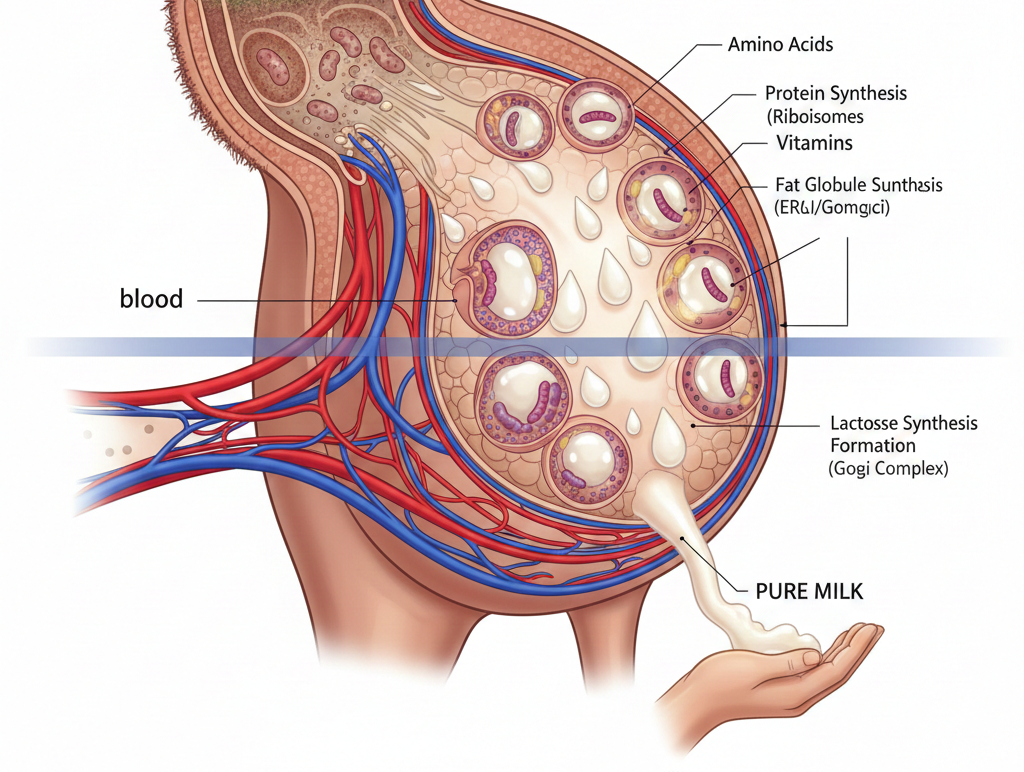
The mammary gland is a highly specialized organ responsible for the synthesis and secretion of milk. Its epithelial cells, known as lactocytes, are equipped with sophisticated biochemical machinery to extract specific precursors from the blood and transform them into the unique components of milk.
1. Synthesis of Milk Proteins
Milk proteins, primarily caseins (αs1, αs2, β, κ-caseins) and whey proteins (α-lactalbumin, β-lactoglobulin, serum albumin, immunoglobulins), are synthesized de novo within the lactocytes [3].
- Amino Acid Uptake: Lactocytes actively absorb essential and non-essential amino acids from the blood plasma.
- Ribosomal Synthesis: These amino acids are then assembled into specific milk proteins on the ribosomes of the endoplasmic reticulum within the lactocytes, following genetic instructions [3].
- Post-Translational Modification: The newly synthesized proteins undergo further modifications (e.g., phosphorylation of caseins) in the Golgi apparatus before being packaged into vesicles for secretion.
2. Synthesis of Milk Fat
Milk fat, primarily in the form of triglycerides, is the most variable component of milk and a significant energy source. Its synthesis involves two main pathways [4]:
- Short- and Medium-Chain Fatty Acids: Acetate and butyrate, absorbed from the rumen into the bloodstream, are taken up by lactocytes and serve as primary precursors for the synthesis of short- (C4-C10) and medium-chain (C12-C16) fatty acids de novo within the mammary gland.
- Long-Chain Fatty Acids: Pre-formed long-chain fatty acids (C18 and above) are derived directly from the animal’s diet and adipose tissue stores. These are transported in the blood as lipoproteins, which are then hydrolyzed at the mammary gland surface, allowing the fatty acids to enter the lactocytes.
- Triglyceride Formation: Inside the lactocytes, these various fatty acids are esterified with glycerol-3-phosphate to form triglycerides, which then coalesce into milk fat globules.
3. Synthesis of Lactose
Lactose, the disaccharide unique to milk, is synthesized exclusively within the mammary gland [5].
- Glucose Uptake: Glucose, supplied by the bloodstream (derived from propionate in ruminants, or direct dietary absorption), is the primary precursor for lactose synthesis.
- Enzymatic Conversion: Inside the Golgi apparatus of the lactocyte, glucose is converted to galactose. Glucose and galactose are then joined by the enzyme lactose synthase (a complex of galactosyltransferase and α-lactalbumin) to form lactose.
- Osmotic Regulation: Lactose is osmotically active, meaning its concentration draws water into the secretory vesicles, ensuring that the final milk volume and consistency are maintained [5].
4. Incorporation of Vitamins and Minerals
Vitamins (e.g., A, D, E, B vitamins) and minerals (e.g., calcium, phosphorus, potassium) are absorbed from the diet into the bloodstream and then actively transported into the lactocytes, where they are incorporated into milk [6]. The mammary gland acts as a filter, concentrating specific micronutrients vital for the offspring’s development.
The “Between Excretions and Blood” Filtration
The Quranic verse’s emphasis on milk being “between excretions and blood” is remarkably precise, even without the detailed knowledge of cellular biology available today.
- Between Excretions: This refers to the rigorous filtration and synthetic processes that occur, separating the valuable nutrients destined for milk from the waste products that are either eliminated as feces (excretions) or processed by the kidneys and liver. The mammary gland does not directly process digestive waste; rather, it selectively draws refined nutrients from the purified bloodstream.
- Between… Blood: This signifies that while milk components are derived from the blood, the blood itself does not directly mix with the milk. The mammary gland acts as a highly selective barrier and synthesis factory. The tight junctions between lactocytes prevent the passage of large molecules and blood cells into the milk, ensuring its purity and sterility. This intricate barrier function is crucial for maintaining the integrity and safety of milk as a nutrient source [7]. The blood acts as the transport medium, delivering the raw materials, but the final product is distinct and purified.
Conclusion
The chemical transformation of ingested feed into pure, palatable milk within the body of a grazing animal is a testament to the sophistication of biological systems. From the initial digestion and absorption of nutrients into the bloodstream to their selective uptake and de novo synthesis within the specialized lactocytes of the mammary gland, every step is meticulously controlled. The Quran’s description of milk production, specifically its origin “between excretions and blood,” resonates powerfully with modern scientific understanding, highlighting a natural process of remarkable filtration, synthesis, and purification that yields a perfect food. This ancient insight, now illuminated by biochemistry and physiology, continues to inspire awe at the intricacies of creation.
References
[1] Volatile Fatty Acids as Precursors for Milk Synthesis.
Review: Bauman, D. E., & Currie, W. B. (1980). Partitioning of nutrients during pregnancy and lactation: a review of mechanisms involving homeostasis and homeorhesis. Journal of Dairy Science, 63(9), 1514-1524.
Link: https://www.journalofdairyscience.org/article/S0022-0302(80)83163-1/fulltext (Access via institutional subscription or ResearchGate)
[2] Nutrient Absorption and Transport to Mammary Gland.
Book Chapter: Neville, M. C., & Walsh, A. (1998). Lactation: Physiology and Biochemistry. In E. R. De Vos (Ed.), Physiology of Reproduction (3rd ed., Vol. 2, pp. 2785-2834). Raven Press. (No direct public link, but fundamental textbook knowledge).
Related review on nutrient partitioning: Reynolds, C. K., Aikman, P. C., & Humphries, D. J. (2007). Nutrient partitioning in the lactating dairy cow: lessons from a decade of research. The Journal of nutrition, 137(3), 754-760.
Link: https://academic.oup.com/jn/article/137/3/754/4664326
[3] Milk Protein Synthesis in Lactocytes.
Review: Farrell, H. M., Jr., Malin, E. L., Brown, E. M., & Hettiarachchy, N. S. (2006). Milk Proteins: An Overview. In Advanced Dairy Chemistry—Volume 1A: Proteins (pp. 1-63). Springer.
Link: https://link.springer.com/chapter/10.1007/0-387-27409-5_1 (Chapter abstract, full access usually via subscription)
[4] Milk Fat Synthesis Pathways.
Review: Grummer, R. R. (1991). Effect of feed on the composition of milk fat. Journal of Dairy Science, 74(3), 1051-1064.
Link: https://www.journalofdairyscience.org/article/S0022-0302(91)78262-1/fulltext
[5] Lactose Synthesis and Osmotic Regulation.
Review: Mather, I. H., & Keenan, T. W. (1998). Origin and secretion of milk lipids. In Advanced Dairy Chemistry—Volume 2: Lipids (pp. 129-170). Springer. (Discusses lactose in context of secretion)
More direct on lactose: Kuhn, N. J. (1983). The biochemistry of lactose synthesis. Trends in Biochemical Sciences, 8(1), 1-3. (Older but foundational)
Link to a relevant summary: https://www.sciencedirect.com/science/article/pii/0968000483900220 (Abstract)
[6] Vitamins and Minerals in Milk.
Review: Lonnerdal, B. (2003). Nutritional and physiological significance of human milk proteins. Advances in Nutritional Research, 11, 155-181. (While focused on human milk, the principles of mammary gland uptake of micronutrients are conserved across mammals).
General review on milk composition: Haug, A., Hostmark, A. T., & Harstad, O. M. (2007). Bovine milk in human nutrition—A review. Lipids in Health and Disease, 6(1), 25.
Link: https://lipi.biomedcentral.com/articles/10.1186/1476-511X-6-25
[7] Mammary Gland Barrier Function and Blood-Milk Barrier.
Review: Rørth, M., & Madsen, L. B. (2018). The mammary gland: a unique organ with highly specific transport and barrier functions. Current Opinion in Physiology, 3, 27-32.
Link: https://www.sciencedirect.com/science/article/pii/S246886731830006X