
Introduction: The Biological-Geological Continuum
The relationship between the chemical composition of the Earth’s lithosphere—specifically in the form of soil and atmospheric dust—and the human biological system is one of the most fundamental yet overlooked areas of modern geochemistry and physiology. While humans perceive themselves as distinct biological entities, at a molecular level, the human body is a subset of the Earth’s crust. Every atom within the human frame, with the exception of those synthesized via nuclear reactions, originates from the geological and atmospheric environment.
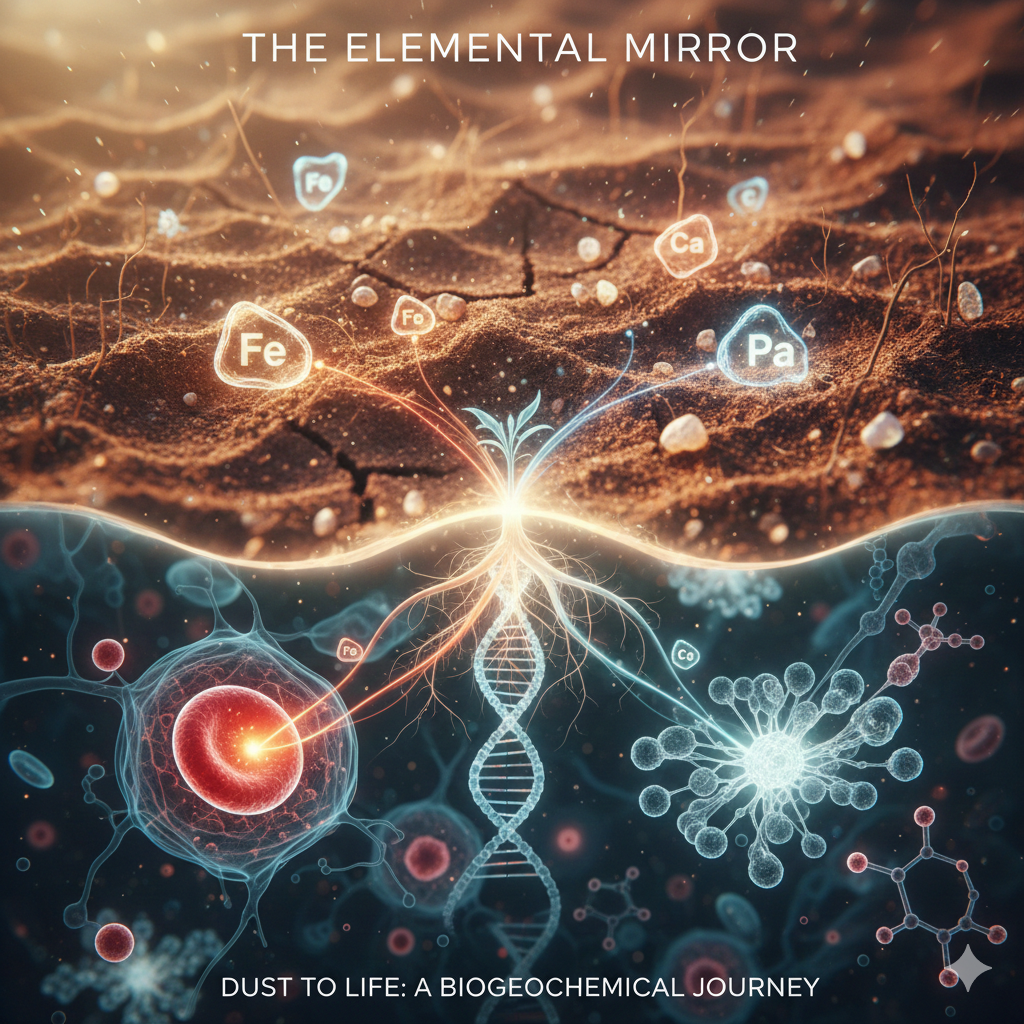
This article explores the “Elemental Mirror”—the scientific reality that the bulk, minor, and trace elements that constitute the human body are identical to those found in the soil-dust of our planet. By examining the chemical profiles of both the lithosphere and human physiology, we can observe the mechanics of biogeochemical cycles that facilitate the transition of elements from “dust” into complex living tissue.
I. The Chemical Profile of the Earth’s Crust and Dust
Soil is essentially weathered parent rock (the lithosphere) mixed with organic matter. Atmospheric dust is the aerosolized fraction of this soil. To understand the human body, one must first understand the “primordial soup” of elements available in the Earth’s upper layers.
1.1 Mineral Composition of Dust
Global mineral dust is primarily composed of silicates, carbonates, and oxides. However, from a biological perspective, the focus is on the elemental ions released during the weathering of these minerals. The Earth’s crust is dominated by eight elements: Oxygen (O), Silicon (Si), Aluminum (Al), Iron (Fe), Calcium (Ca), Sodium (Na), Magnesium (Mg), and Potassium (K).
1.2 Availability and Bio-accessibility
Not all elements in the soil are immediately bio-available. For an element to transition from “dust” to “human,” it must first be soluble or captured by biological vectors (plants and microorganisms). Elements like Phosphorus (P) and Nitrogen (N), though not the most abundant in the crust, are concentrated in the soil’s organic layer, forming the backbone of what scientists call the Critical Zone—the layer of the Earth where rock meets life.
II. The Human Elemental Blueprint
The human body is an intricate assembly of approximately $7 \times 10^{27}$ atoms. When stripped of their molecular structure, these atoms reveal a chemical list that matches the Periodic Table’s distribution in the Earth’s environment.
2.1 The Major Elements (The Bulk)
Four elements—Hydrogen, Oxygen, Carbon, and Nitrogen—make up about 96% of the human body mass.
- Oxygen (~65%) and Hydrogen (~10%): Primarily found in water, these are derived from the hydrosphere and the mineral-bound water in the crust.
- Carbon (~18%): The basis of organic chemistry, Carbon is recycled through the soil-atmosphere-biosphere loop.
- Nitrogen (~3%): Though abundant in the atmosphere, biological nitrogen is derived from soil-based nitrogen fixation.
2.2 The Macrominerals (The Structural Bridge)
The remaining 4% of the human body is where the “soil-dust” connection becomes most visible. These are the elements that provide structural integrity and electrochemical potential:
- Calcium (Ca): The most abundant mineral in the body (found in bones/teeth), directly mirrored by its abundance in the Earth’s crust as carbonates and silicates.
- Phosphorus (P): Critical for DNA and energy transfer (ATP). Phosphorus is a “limiting factor” in soil, meaning the growth of life is directly tied to the availability of phosphorus in the dust/earth.
- Potassium (K), Sodium (Na), and Chlorine (Cl): The electrolytes that govern cellular fluid balance. These are the primary salts found in the Earth’s crust and oceans.
III. Trace Elements: The Catalytic Link
Perhaps the most fascinating aspect of the “dust-to-human” connection is the Trace Elements. Although they make up less than 1% of the body’s mass, life is impossible without them. These elements are sourced exclusively from the geological environment (soil-dust) and must be ingested.
3.1 Iron (Fe)
Iron is a major component of the Earth’s core and crust. In the human body, it is the central atom of the hemoglobin molecule, responsible for oxygen transport. Without the iron available in the Earth’s “dust,” aerobic life would cease to exist.
3.2 Zinc (Zn), Copper (Cu), and Manganese (Mn)
These elements serve as “cofactors” for enzymes. An enzyme is a biological machine, and the “spark plug” of that machine is often a metal ion derived from the soil. Zinc, for example, is involved in over 300 enzymatic reactions in the human body, including DNA synthesis and immune function.
3.3 The Rare Essentials: Selenium and Iodine
Elements like Selenium (Se) are found in trace amounts in certain soils. Humans require Selenium for antioxidant protection. The concentration of Selenium in local human populations is often directly correlated with the concentration of Selenium in the local soil/dust.
IV. Biogeochemical Cycles: The Mechanism of Transition
How does the “dust of the earth” become the “flesh of a human”? This occurs through a series of Biogeochemical Cycles—the movement of matter through the Earth’s systems.
4.1 The Soil-Plant-Human Pathway
Plants act as the primary biological miners of the Earth. They extend roots into the soil, using chemical secretions to dissolve minerals. They absorb the elements (Calcium, Magnesium, Iron, etc.) and incorporate them into their tissues. When humans consume these plants (or animals that have eaten the plants), those geological elements are integrated into human cells.
4.2 The Decomposition Loop
The cycle is a closed loop. Upon the death of a biological organism, the process of decomposition (facilitated by bacteria and fungi) breaks down complex organic molecules back into their elemental forms. Carbon is released as gas, while the minerals (Calcium, Iron, Phosphorus) return to the soil as dust. This is the scientific definition of “returning to the earth.”
V. Comparative Table: Earth’s Crust vs. Human Body
| Element | Role in Earth’s Crust/Dust | Role in Human Body |
| Oxygen | Major component of silicates/oxides | Solvent (Water), Cellular Respiration |
| Carbon | Found in carbonates and organic matter | Structural backbone of all organic molecules |
| Hydrogen | Found in minerals and water | Fluid balance, pH levels |
| Nitrogen | Fixed in soil by bacteria | Component of Proteins and DNA |
| Calcium | Found in Limestone and Gypsum | Bone structure, muscle contraction |
| Phosphorus | Found in Phosphate rocks | DNA, RNA, ATP (Energy) |
| Iron | Found in Hematite and Magnetite | Oxygen transport in Blood |
VI. Conclusion: The Earthly Origin of Life
From a strictly geochemical perspective, the human body is a highly organized form of “processed earth.” Every mineral that enables our heart to beat, our bones to support our weight, and our brains to process thought is a loan from the planet’s crust.
The scientific reality of the biogeochemical cycle confirms that we are part of a continuous exchange system. We are composed of the same elements found in the dust of the ground, we sustain ourselves by consuming those same elements, and eventually, through the laws of thermodynamics and biology, those elements return to the soil to potentially form the dust of future generations.
Holy Qur’an (Koran) already explained this in Chapter 20 (Taa Haa) Verse 55. Translation:
“From it (the earth) We created you, into it We shall return you, and from it We shall bring you out once more.”
VII. Authoritative References and Footnotes
- Steffan, J. J., et al. (2018). The effect of soil on human health: an overview. European Journal of Soil Science. This paper details how the elemental composition of soil directly dictates the nutritional profile of human populations. Link to Article
- Chopra, A., & Lineweaver, C. H. (2010). The Elemental Composition of Life. This study compares the bulk elemental abundances in the universe, the Sun, the Earth, and life, highlighting the specific “selection” of crustal elements by biological systems. Link to Research
- Hasan, S. E. (2021). Medical Geology: Impact of the Natural Environment on Public Health. This text explores how the geological distribution of elements in dust and soil affects human health and physiology. Link to Encyclopedia Chapter
- National Center for Biotechnology Information (NCBI). Modern Nutrition in Health and Disease. A comprehensive look at how trace elements from the earth function as essential micronutrients in human metabolism. Link to NCBI Bookshelf
- Boyle, R. A., et al. (2025). Persistence selection between simulated biogeochemical cycle variants. Proceedings of the National Academy of Sciences (PNAS). This recent study discusses the stability of these cycles over billions of years. Link to PNAS
- Selinus, O. (2013). Essentials of Medical Geology. This foundational book outlines the chemical link between the earth (rocks/soil) and the biological health of animals and humans. Link to Springer
Read more article about The Creation of Everything from Water and The Miracle of the Fingertip