
The preservation of the Pharaohs remains one of the most remarkable intersections of ancient ritual and modern forensic science. While thousands of years have passed, the bodies of these rulers provide a vivid window into the past, supported by both archaeological records and religious texts.
1. The Science of the “Eternal Body”
The ancient Egyptians perfected mummification not merely for hygiene, but because they believed the soul (Ka) required a physical home to survive in the afterlife.
- The Desiccant: The primary tool was Natron, a naturally occurring salt (sodium carbonate and sodium bicarbonate) harvested from dry lake beds. It acted as a powerful dehydrator, stopping the bacterial decay that follows death.
- The Timeline: The process typically lasted 70 days, involving the removal of most internal organs (except the heart) and treating the remains with anti-bacterial resins and oils.
- Source: McGill University: Of Mummies, Pigments and Pretzels
2. Ramesses II: The Pharaoh with a Passport
Ramesses II (Ramesses the Great) is perhaps the most famous preserved Pharaoh. In 1974, his mummy began to show signs of deterioration due to a fungal infection. To transport him to France for treatment, the Egyptian government took a unique step.
- The Passport: Legend (and some official accounts) states he was issued an Egyptian passport with the occupation “King (deceased)” to comply with French laws requiring valid identification for all persons entering the country.
- Military Honors: When his body arrived at Le Bourget airport in Paris, he was greeted with a full military procession and a head-of-state welcome.
- Scientific Findings: Examination by French scientists revealed he had red hair (dyed with henna), a hooked nose, and lived into his 90s despite severe arthritis.
- Source: HistoryExtra: Did Ramesses II really have a passport?
3. Merneptah: The Pharaoh of the Exodus?
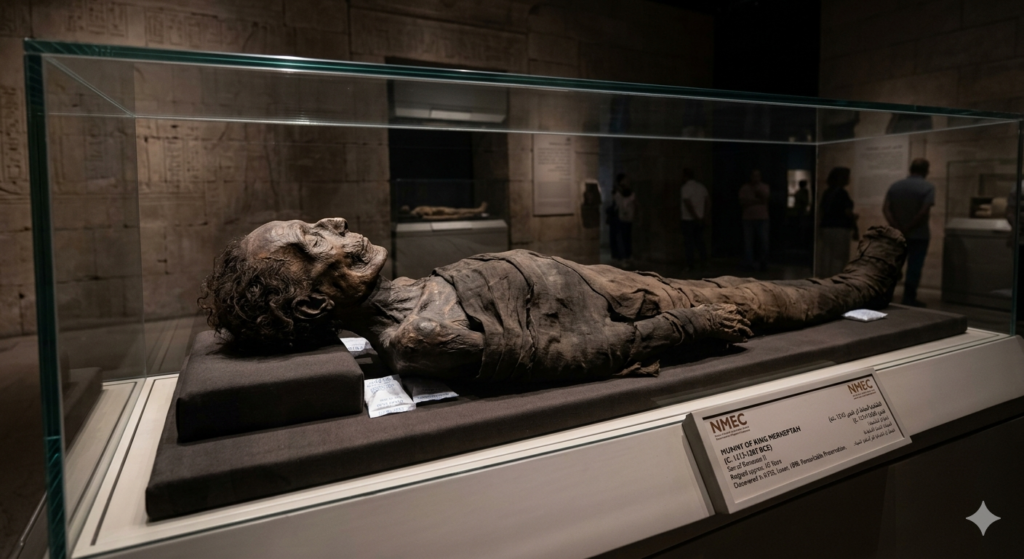
The preservation of Merneptah (son of Ramesses II) is often cited in religious discussions. His mummy was discovered in 1898 by Victor Loret in the tomb of Amenhotep II.
- The Religious Sign: In the Quran (Surah Yunus 10:92), God addresses the Pharaoh who pursued Moses: “So today We will save you in body that you may be to those who succeed you a sign.”
- The “Salt” Controversy: In the 1970s, Dr. Maurice Bucaille examined Merneptah’s mummy and claimed to find traces of “sea salt” and evidence of internal trauma consistent with drowning. While some archaeologists argue that salt (natron) is a standard part of all mummification, the specific condition of Merneptah’s body remains a focal point for those linking him to the Exodus story.
- Source: ResearchGate: Identifying Merenptah as the Exodus-Pharaoh
4. Current Location: The NMEC
In April 2021, Egypt held the “Pharaohs’ Golden Parade,” a massive spectacle where 22 royal mummies were moved through the streets of Cairo to their new permanent home.
- The Museum: You can now view these remarkably preserved bodies at the National Museum of Egyptian Civilization (NMEC). They are housed in the Royal Mummies Hall, designed to mimic the atmosphere of the Valley of the Kings.
- Display: They are kept in nitrogen-filled, climate-controlled glass cases to ensure they remain preserved for another several thousand years.
- Source: Official NMEC Website: Mummies Hall
Quran already mentioned about the preservation of Pharaoh’s body. Read Quran Chapter 10. Verse 92. The translation is “So today We will save you in your body so that you may be a sign for those who come after you…”
Summary Table: Key Preserved Pharaohs
| Pharaoh | Reign (Approx) | Notable Feature | Discovery Year |
| Seti I | 1290–1279 BCE | Known as the “best-preserved” mummy; retains lifelike features. | 1881 |
| Ramesses II | 1279–1213 BCE | Travelled to Paris for fungal treatment; original red hair. | 1881 |
| Merneptah | 1213–1203 BCE | Linked by some to the Biblical/Quranic Exodus. | 1898 |
| Tutankhamun | 1332–1323 BCE | Only royal tomb found largely intact; preserved in situ for decades. | 1922 |