

“And of everything We have created pairs, that you may remember.”
— Surah Az-Zariyat (51:49), The Quran
More than 1,400 years ago, the Quran made a profound statement about the nature of creation: that all things were created in pairs. At a time when the prevailing understanding of biology was rudimentary at best, this revelation seemed like a simple observation. Today, modern science has uncovered the depth of this statement across multiple fields — from genetics and botany to particle physics. This article explores how the Quran accurately described the principle of pairing in creation centuries before modern scientific discovery.
1. Pairs in Plant Biology: Male and Female Reproductive Systems
The Quran specifically mentions pairs in vegetation. In Surah Ar-Ra’d (13:3), Allah says: “And of all fruits, He made pairs, two of every kind.” This was a remarkable statement at a time when the sexual reproduction of plants was completely unknown.
It was not until the 17th century that European botanists began to understand plant reproduction. In 1694, German botanist Rudolf Jakob Camerarius published his landmark work “De Sexu Plantarum” (On the Sex of Plants), providing the first scientific demonstration that plants have male and female reproductive organs. He discovered that the stamens function as male organs and the pistils as female organs — a revelation that fundamentally changed botanical science.
Today we know that the vast majority of flowering plants (angiosperms) have both male and female reproductive structures, and many plant species have separate male and female individuals (dioecious plants). This includes common plants such as date palms, willows, and spinach — precisely the types of fruits and vegetation the Quran references. Modern botany has confirmed that plant sexual reproduction involves pollen transfer, fertilization, and seed formation, exactly mirroring the “pairing” concept described in the Quran.
2. Pairs in Human Genetics: The Discovery of Chromosome Pairing
The Quran also mentions pairs “from themselves” — meaning from human beings themselves. In Surah An-Najm (53:45), Allah declares: “And that He creates the two mates — the male and the female.”
This verse takes on extraordinary significance when viewed through the lens of modern genetics. In 1956, Joe Hin Tjio and Albert Levan definitively determined that human cells contain 23 pairs of chromosomes (46 total) — a discovery that laid the foundation for modern cytogenetics. Each pair consists of one chromosome inherited from the mother and one from the father, forming a perfect biological pair.
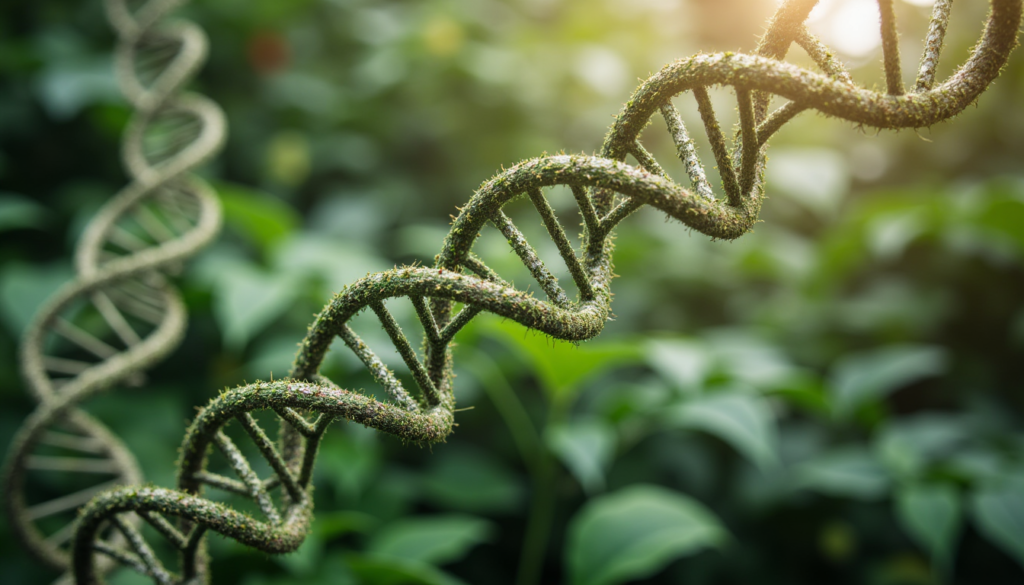
The DNA double helix itself, discovered by Watson and Crick in 1953, is fundamentally a paired structure — two complementary strands bound together by hydrogen bonds. The base pairing rules (Adenine-Thymine and Cytosine-Guanine) represent pairing at the molecular level. Every aspect of human heredity is based on pairing mechanisms: allele pairing, nucleotide base pairing, and homologous chromosome pairing during meiosis.
Furthermore, in 1972, scientists discovered that the SRY gene on the Y chromosome determines male sex development, providing the genetic basis for why humans are created in male and female pairs — exactly as stated in the Quran 14 centuries earlier.
3. Pairs Beyond Biology: What Modern Science Continues to Discover
Remarkably, the Quran states “of everything We have created pairs” — not just in biology. And in Surah Ya-Sin (36:36), it adds: “Exalted is He who created all pairs — from what the earth grows and from themselves and from that which they do not know.”
The phrase “that which they do not know” is particularly striking. Modern science has discovered pairing at levels that would have been unimaginable in the 7th century:
- Subatomic Particles and Antimatter (1932) — Physicist Carl D. Anderson discovered the positron (the antimatter counterpart of the electron), proving that every particle has an antiparticle pair. The Standard Model of particle physics now recognizes that for every fundamental particle, there exists a corresponding antiparticle.
- Quantum Entanglement (1935) — Einstein, Podolsky, and Rosen described the phenomenon where pairs of particles become linked such that measuring one instantaneously affects the other, regardless of distance — a fundamental pairing at the quantum level.
- Binary Star Systems — Astronomers estimate that more than 50% of stars in the Milky Way exist in binary or multiple star systems — stellar pairs orbiting around a common center of gravity.
- Complementary Proteins (1950s) — Molecular biology revealed that proteins bind to specific complementary partners through lock-and-key mechanisms, from enzymes and substrates to antibodies and antigens.
In a fascinating study published in Nature Physics (2015), researchers at MIT demonstrated that quantum mechanics requires the existence of paired states for all physical systems, confirming the fundamental nature of pairing at the most basic level of reality.
For further reading on how the Quran anticipated modern scientific discoveries, see our article on Iron Sent Down from the Sky: How the Quran Revealed Extraterrestrial Iron and The Water Cycle in the Quran.
Conclusion
The Quran’s declaration that all things are created in pairs represents one of the most remarkable scientific insights contained in scripture. From the chromosomal pairs that carry our genetic information to the male and female organs in plants, from complementary DNA strands to particle-antiparticle pairs in quantum physics — the principle of pairing pervades all of creation.
What makes this particularly significant is that when the Quran was revealed in the 7th century, none of these scientific facts were known. The microscope had not yet been invented. The concept of cells and chromosomes was over a millennium away. Particle physics was beyond human imagination. Yet the Quran stated clearly and unequivocally that pairs exist in all of creation — a truth that modern science continues to validate with each new discovery.
As the Quran itself says: “We will show them Our signs in the horizons and within themselves until it becomes clear to them that this is the truth.” — Surah Fussilat (41:53).