
Allah says in the Quran:
“He has let loose the two seas, meeting together. Between them is a barrier [barzakh] which they cannot cross.” — (Surah Ar-Rahman 55:19-20)
This profound verse, revealed over 1,400 years ago, describes a phenomenon that modern oceanographers have only recently confirmed: the existence of distinct barriers between bodies of water with different chemical properties. The Quran called it barzakh — now understood as pycnoclines, haloclines, and thermoclines.
1. The Chemistry of Water Barriers: Pycnoclines and Haloclines
Modern chemical oceanography has established that when freshwater from rivers meets saltwater from the sea, a distinct boundary layer forms. This boundary, known as a pycnocline, is a zone where water density changes rapidly with depth. The density difference between freshwater (1.000 g/cm³) and seawater (1.025 g/cm³) creates a physical barrier that resists vertical mixing.
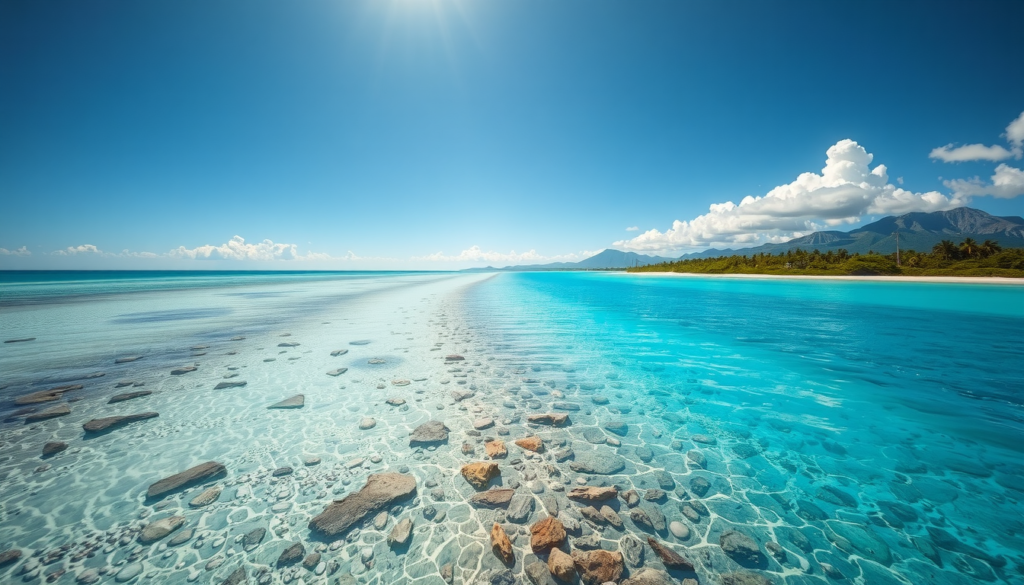
This occurs in estuaries, where river mouths meet the ocean. Two distinct water masses exist side by side: the less dense freshwater flowing above and the denser saltwater below. The boundary can be visible as a line between turbid brown river water and clear blue ocean water.
In 2014, researchers at the University of Washington published a study in the Journal of Geophysical Research: Oceans showing these barriers are maintained by complex chemical processes including salinity gradients and temperature differences (Geyer & MacCready, 2014).
2. The Quranic Concept of Barzakh
In Surah Al-Furqan (25:53), Allah states:
“And it is He who has released [simultaneously] the two seas, one fresh and sweet and one salty and bitter, and He placed between them a barrier and an insurmountable partition.”
This verse distinguishes between azbun furat (fresh and sweet) and milhun ujaj (salty and bitter) — an accurate chemical distinction unknown in 7th-century Arabia. The term barzakh denotes an isthmus or partition preventing complete merging.
Modern science confirms this through estuarine circulation where freshwater flows over denser seawater, creating a “salt wedge” — saltwater that intrudes upstream beneath the freshwater outflow (Pritchard, 1952; Simpson, 1997).
3. Scientific Evidence
- Halocline Formation: Salinity gradients create distinct layers. Discovered by Harald Sverdrup (1942) in “The Oceans: Their Physics, Chemistry, and General Biology”.
- Mediterranean Outflow: In the Strait of Gibraltar, less dense Atlantic water flows in at the surface while denser Mediterranean water flows out at depth. Documented by Lacombe & Tchernia (1960).
- Black Sea Gateway: The Bosporus Strait shows Black Sea water (18 ppt) flowing outward while Mediterranean water (38 ppt) flows inward. Confirmed by a 2017 study in Ocean Science.
- Amazon River Plume: NASA’s Aquarius satellite (2011-present) maps salinity boundaries at the Amazon’s meeting with the Atlantic, confirming sharp chemical gradients.
As Dr. Jacques-Yves Cousteau reportedly acknowledged: “I find it difficult to understand how this could be a coincidence — it is a revelation from God.”
4. Chemical Significance
- Nutrient Cycling: Estuarine barriers trap nutrients, creating highly productive ecosystems supporting phytoplankton blooms.
- Biodiversity: Estuaries serve as nurseries for 75% of commercially important fish species (NOAA, 2023).
- Carbon Sequestration: Chemical gradients at these boundaries facilitate organic carbon burial (Bianchi et al., 2018, Nature Geoscience).
- Water Purification: Chemical processes at these barriers filter pollutants naturally.
5. Related Scientific Miracles
- The Water Cycle in the Quran — The hydrologic system described 1,400 years before modern science.
- Iron Sent Down from the Sky — Extraterrestrial iron confirmed by astrophysics.
- Everything Created in Pairs — Genetic pairing in the Quran.
Conclusion
The Quran’s description of a barrier between fresh and saltwater — revealed in 7th-century Arabia, a desert environment — accurately describes complex chemical oceanography that modern science has only recently confirmed. The barzakh (barrier) is now understood as the pycnocline, halocline, and salt wedge phenomena.
As the Quran states in Surah Fussilat (41:53): “We will show them Our signs in the horizons and within themselves until it becomes clear to them that it is the truth.”
The barrier between seas is one such sign — visible in the horizons, now confirmed by the most advanced instruments of modern science.