
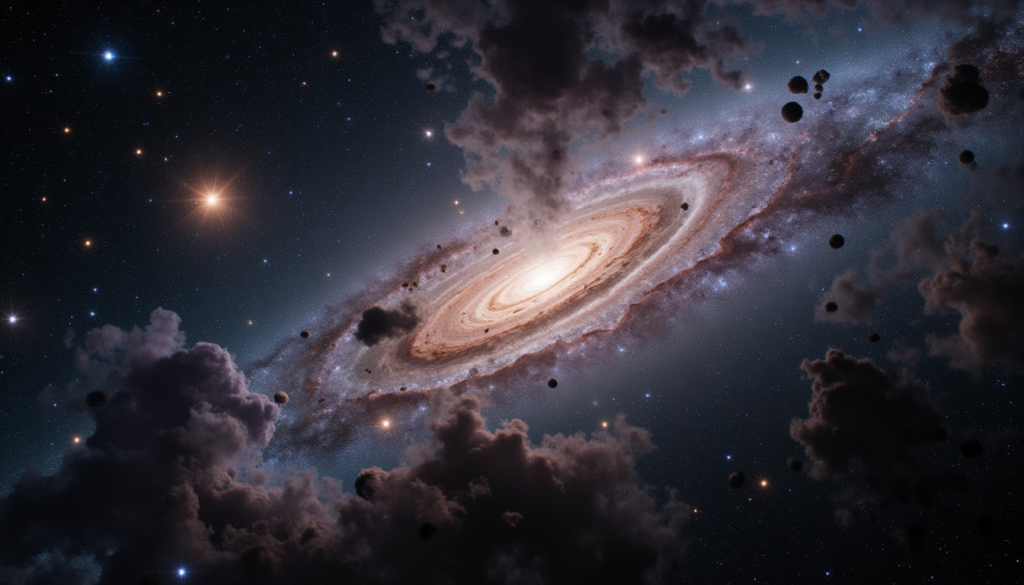

The Qur’an, revealed over 1,400 years ago to Prophet Muhammad (peace be upon him), contains numerous verses that describe natural phenomena with astonishing accuracy. One of the most profound examples is found in Surah Adh-Dhariyat (51:47), where Allah declares:
“And the heaven We constructed with strength, and indeed, We are [its] expander.” (Quran 51:47)
The Arabic word used here — “lamoosi’oon” (مُوسِعُونَ) — comes from the root w-s-‘a, which means to widen, extend, or expand. This single verse describes a cosmic reality that humanity would not discover until the early 20th century: the expansion of the universe.
1. The Discovery of Universal Expansion
In 1929, American astronomer Edwin Hubble made a groundbreaking observation that would forever change our understanding of the cosmos. Using the 100-inch Hooker Telescope at Mount Wilson Observatory, Hubble discovered that galaxies are moving away from Earth at speeds proportional to their distance — a relationship now known as Hubble’s Law.
Hubble’s observations showed that the light from distant galaxies was shifted toward the red end of the spectrum (redshift), indicating they were moving away from us. The farther a galaxy was, the faster it appeared to be receding. This led to the revolutionary conclusion that the universe itself is expanding.
This discovery, published in Proceedings of the National Academy of Sciences in 1929 (Hubble, 1929, “A Relation between Distance and Radial Velocity among Extra-Galactic Nebulae”), provided the first observational evidence for what would later become the Big Bang theory.
2. The Quranic Revelation of Cosmic Expansion
The Arabic verb “nusi’u” (نُوسِعُ) in Quran 51:47 is a first-person plural imperfect verb indicating continuous action — “We are expanding.” This grammatical construction implies an ongoing process, not a one-time event. Modern cosmology confirms exactly this: the universe has been expanding since the Big Bang approximately 13.8 billion years ago and continues to expand today.
Several classical Quranic commentators understood the expansive meaning of this verse long before modern telescopes:
- Ibn Kathir (d. 774 AH / 1373 CE) commented that the verse refers to how Allah expanded the heavens, making them vast and wide.
- Al-Tabari (d. 310 AH / 923 CE) interpreted “We are its expander” as meaning Allah made the heavens spacious and vast.
- Al-Qurtubi (d. 671 AH / 1273 CE) connected this expansion to Allah’s infinite power and ability to create beyond human comprehension.
What makes this particularly remarkable is that the dominant cosmological model in 7th-century Arabia was a flat, dome-shaped sky — the geocentric Ptolemaic model. No scientific knowledge available at the time could have informed the author of the Quran about an expanding universe.
3. Modern Scientific Evidence for the Expanding Universe
The expansion of the universe is now one of the most well-established facts in modern cosmology, supported by multiple independent lines of evidence:
- Galactic Redshift (1929): Edwin Hubble’s observation that galaxies farther from Earth exhibit greater redshift, proving they are receding faster. This remains the foundational evidence for universal expansion.
- Cosmic Microwave Background Radiation (1965): Discovered by Arno Penzias and Robert Wilson at Bell Labs (Nobel Prize in Physics, 1978), the CMB is the faint “afterglow” of the Big Bang. Its uniformity across the sky confirms the universe expanded from an extremely hot, dense state. Precise measurements by the Planck satellite (2013-2018) have mapped this radiation with extraordinary accuracy.
- Accelerating Expansion (1998): In a stunning discovery that earned Saul Perlmutter, Brian Schmidt, and Adam Riess the 2011 Nobel Prize in Physics, observations of Type Ia supernovae revealed that the universe’s expansion is actually accelerating — driven by a mysterious force called dark energy. The Quran’s use of the continuous present tense (“We are expanding”) aligns beautifully with this ongoing, accelerating expansion.
- Hubble Space Telescope Observations: Over three decades of observations have refined our measurements of the Hubble Constant (the rate of universal expansion), currently estimated at approximately 67-73 km/s per megaparsec depending on the measurement method used.
- Large-Scale Structure Formation: Computer simulations of cosmic evolution, combined with galaxy surveys like the Sloan Digital Sky Survey (SDSS), show that the observed distribution of galaxies is only possible in an expanding universe that began with a Big Bang.
Dr. Michał Heller, a cosmologist and Templeton Prize winner, has written extensively on the philosophical implications of cosmic expansion, noting that the idea of a universe with a beginning and ongoing expansion aligns with theological concepts of creation found in Abrahamic scriptures, including the Quran.
Conclusion
Quran 51:47 stands as one of the most compelling examples of scientific foresight in religious scripture. At a time when the prevailing worldview held that the cosmos was static and unchanging, the Quran declared that the heavens are being expanded — a fact that modern science only confirmed fourteen centuries later.
This is not a coincidence but a sign — as the Quran itself says in numerous verses — for those who reflect. The verse invites humanity to observe the universe, contemplate its nature, and recognize the wisdom embedded in creation.
The expanding universe, first measured by Hubble in 1929 and now mapped in exquisite detail by space observatories, confirms what the Quran revealed in the 7th century: the cosmos is not static but dynamic, growing, and continuously expanding under the command of its Creator.
For further reading, explore our article on Iron Sent Down from the Sky: How the Quran Revealed Extraterrestrial Iron and The Spherical Earth is Already Revealed by Quran.