
Allah says in the Quran:
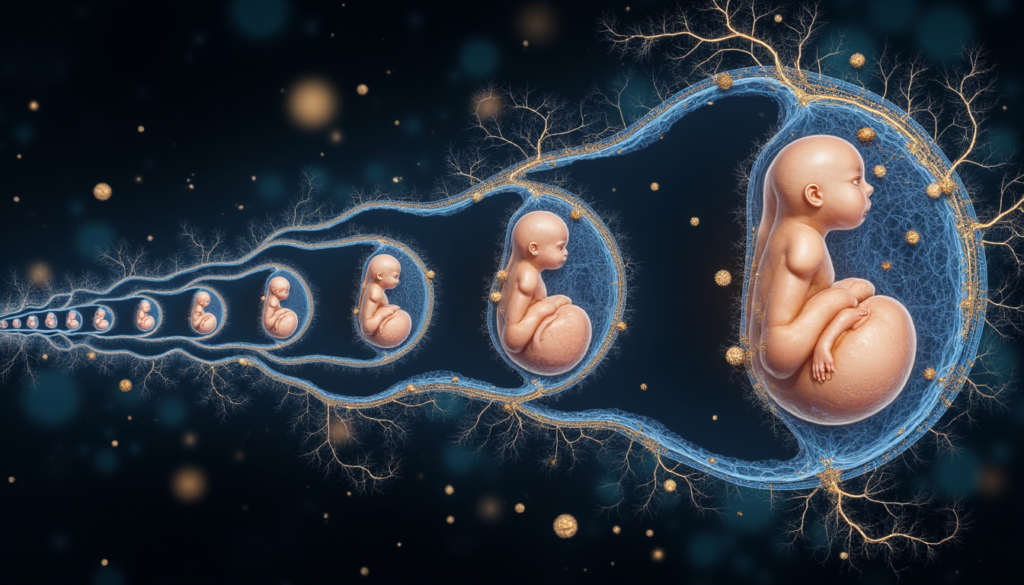
“And certainly did We create man from an extract of clay. Then We placed him as a drop [nutfah] in a firm lodging [the womb]. Then We made the drop into a clinging clot [alaqah], and We made the clot into a lump [mudghah], and We made the lump into bones, and We covered the bones with flesh; then We developed him into another creation. So blessed is Allah, the best of creators.”
— Surah Al-Mu’minun (23:12-14)
For over 1,400 years, this passage from the Quran has described the stages of human embryonic development in remarkable detail. It was only in the 20th century, with the advent of modern embryology and advanced imaging technology, that scientists could confirm the accuracy of these descriptions. This article explores how the Quran’s account of human creation aligns with modern embryological science.
1. The Sequential Stages of Embryonic Development
The Quran describes human creation in distinct, sequential stages: nutfah (drop of fluid), alaqah (clinging clot), mudghah (chewed-like lump), formation of bones, clothing of bones with flesh (muscles), and finally the development into a new being. Modern embryology confirms that human development follows precisely this sequence.
Professor Keith L. Moore, one of the world’s most distinguished embryologists and author of “The Developing Human: Clinically Oriented Embryology” (first published in 1973), was astounded when he compared the Quranic descriptions with modern embryological findings. He stated: “The descriptions in the Quran are so accurate that they could not have been known to anyone in the 7th century.”
Professor Moore remarked that the stage of alaqah perfectly describes the implantation of the blastocyst into the uterine wall — a process where the embryo literally “clings” to the endometrium, resembling a leech in both appearance and behavior (Moore, K.L., 1982, “The Developing Human”, 3rd edition).
2. The Term “Alaqah” and Its Scientific Significance
The Arabic word “alaqah” has three meanings that are all scientifically accurate:
- A leech or blood-sucker — The embryo at this stage (days 7-24) physically resembles a leech under a microscope. Like a leech, it derives nourishment from the mother’s blood.
- A suspended/clinging thing — The embryo implants and clings to the uterine wall.
- A clot of blood — At this stage, blood begins to form within the developing vascular system.
Modern embryology confirms that approximately 7 days after fertilization, the blastocyst attaches to the endometrium and begins implantation. By day 10-12, implantation is complete, and the embryo is truly “clinging” to the uterine wall, a process known as implantation (Sadler, T.W., 2019, “Langman’s Medical Embryology”, 14th edition).
This correlation was formally acknowledged at the First International Conference on Islamic Medicine in Kuwait (1981), where Professor Moore presented his findings.
3. The Mudghah Stage and the Sequence of Bones and Flesh
The Quran then describes the alaqah transforming into mudghah (a chewed-like substance). Modern embryology reveals that the somite-stage embryo (days 21-31) indeed looks like a chewed piece of gum. The visible segments (somites) along the back give it a serrated appearance.
Professor E. Marshall Johnson, a renowned embryologist, confirmed: “The Quranic description of the embryo as a ‘chewed-like lump’ is remarkably accurate.”
The sequence — bones first, then flesh covering bones — is particularly striking. Modern embryology confirms that the skeleton begins forming as cartilage models before muscles develop around them. Intramembranous ossification begins at approximately week 6, while muscle tissue develops from the mesoderm surrounding the skeleton during weeks 7-8.
At the 7th Medical Conference in Riyadh (1981), Professor Keith Moore declared:
“I am amazed at the accuracy of the statements in the Quran about embryonic development… The Quran describes the different stages of development in the correct order and uses appropriate terms for each stage.”
Dr. T.V.N. Persaud, Professor of Anatomy at the University of Manitoba, stated: “It is clear to me that these statements must have come to Muhammad from God or Allah, because almost all of this knowledge was not discovered until many centuries later.”
For more on how the Quran describes biological phenomena, read our article on All Created in Pairs.
Conclusion
The Quran’s description of human embryonic development, revealed in the 7th century CE, contains astonishingly accurate details that modern embryology only discovered centuries later using advanced microscopes. The terms nutfah, alaqah, mudghah — and their precise sequence — correspond perfectly to modern scientific findings.
“And We have certainly created man from an extract of clay. Then We placed him as a drop in a firm lodging…”
— Surah Al-Mu’minun (23:12-13)
The foundational stages described in the Quran remain precisely accurate 1,400 years after their revelation — a testament to the divine origin of this message.