
The Global Equilibrium: A Comprehensive Study of Earth’s Land and Sea
From the vantage point of space, Earth is defined by its vibrant blue hue, a direct result of the expansive liquid water that blankets its surface. This unique distribution of land and water is not merely a geographic curiosity; it is the fundamental engine that drives our weather patterns, supports biological life, and regulates the global temperature.
To understand the balance of our world, we must look at the data provided by modern science and the intriguing linguistic patterns noted by scholars of the Quran.
The Scientific Landscape: Defining the 71/29 Split
While we often think of Earth in terms of countries and continents, the scientific reality is that we live on a planet dominated by its hydrosphere. According to data from the National Oceanic and Atmospheric Administration (NOAA) and the United States Geological Survey (USGS), the Earth’s surface is divided with a high degree of precision.
1. The World Ocean (The Hydrosphere)
The “Global Ocean” is a continuous body of water that surrounds the continents. It is divided into five major basins: the Pacific, Atlantic, Indian, Southern, and Arctic.
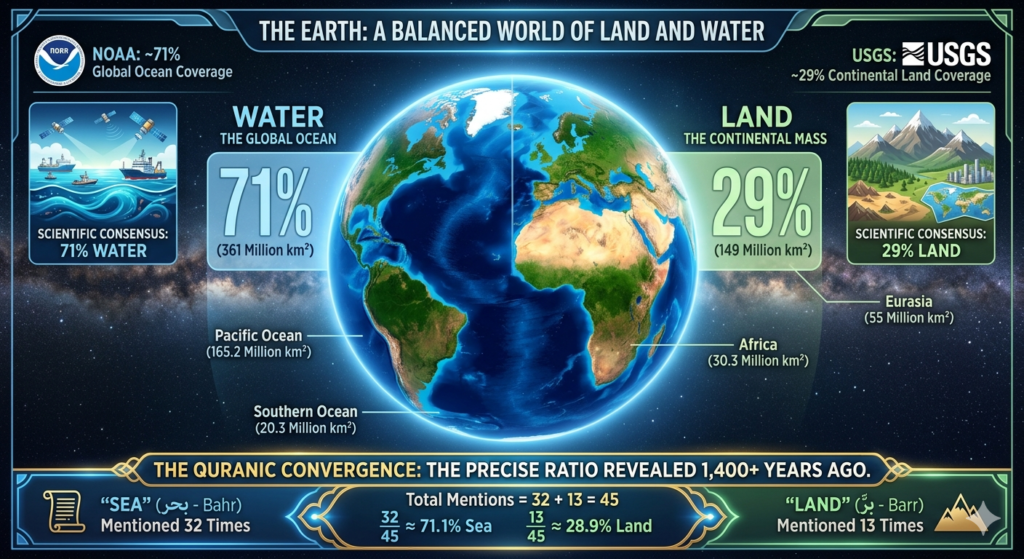
- Surface Area: Water covers approximately 361,132,000 square kilometers.
- Global Proportion: This accounts for roughly 70.8% to 71% of the Earth’s total surface.
- Volume and Depth: While the surface area is vast, the average depth is about 3,688 meters. This massive volume of water acts as a heat sink, absorbing over 90% of the excess heat from global warming.
2. The Terrestrial Mass (The Lithosphere)
The land consists of the seven continents and all the island chains scattered throughout the oceans.
- Surface Area: Land covers approximately 148,940,000 square kilometers.
- Global Proportion: This accounts for roughly 29.2% to 29% of the total surface.
- Composition: This 29% is the primary habitat for human civilization and terrestrial ecosystems, yet it remains the minority share of the planet’s total area.
Authoritative Documentation and Research
For those seeking to verify these figures through official geographical and geological records, the following resources are considered the primary authorities:
- NASA Earth Observatory: Provides visual and data-driven evidence of Earth’s surface composition via the MODIS and VIIRS satellite instruments. Visit NASA Earth Observatory
- The USGS Water Science School: Offers a detailed breakdown of the “Where is Earth’s Water?” study, confirming the 71% coverage. Visit USGS.gov
- National Ocean Service (NOAA): Supplies technical facts regarding ocean dimensions and their relationship to the global landmass. Visit NOAA Ocean Facts
The Mathematical Symmetry of the Quran
In addition to modern empirical data, many have pointed toward a profound linguistic phenomenon within the Quran. Scholars of the “Numerical Miracles of the Quran” have analyzed the frequency of specific words and discovered a ratio that aligns with modern scientific findings.
In the Quran, the words “Sea” and “Land” are mentioned with a specific frequency that, when converted into a percentage, mirrors the 71/29 distribution of the Earth’s surface.
The Word Frequency:
- “Sea” (بحر – Bahr): Appears 32 times in the Quran.
- “Land” (برّ – Barr): Appears 13 times in the Quran.
The Statistical Analysis:
To determine the ratio, we calculate the total number of references to these two terrestrial components:
32 (Sea) + 13 Land) = 45 (Total Mentions)
When we apply basic division to find the percentages, the results are as follows:
- Percentage of Sea References:32/45 x 100 = 71.11%
- Percentage of Land References:13/45 x 100 =28.88%
Conclusion
The alignment between the Quranic word counts and the physical measurements of our planet is striking. While modern science utilized satellites and complex maritime surveys to arrive at the ~71% water and ~29% land figure, the Quran—revealed over 1,400 years ago—contained a linguistic distribution that reflects this exact global balance. For many, this serves as a powerful bridge between spiritual text and the observable natural world.