
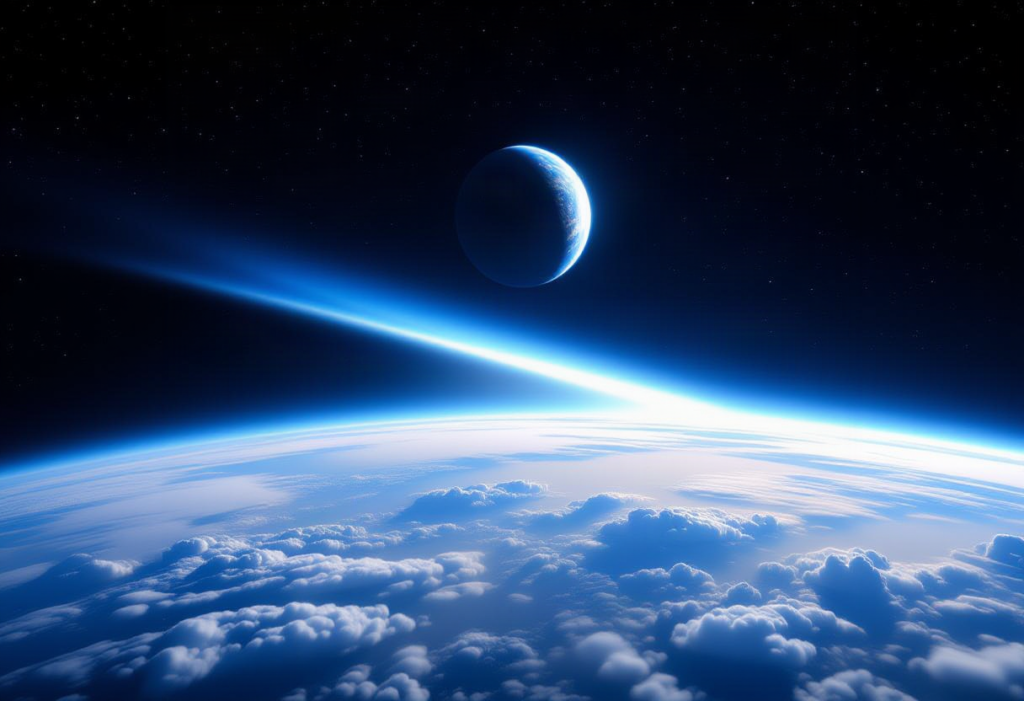

Few Quranic phrases have attracted as much modern commentary as sab’a samawat—the “seven heavens.” For readers interested in harmony between scripture and science, the layered atmosphere is often proposed as a striking parallel. This article examines three key verses, summarises what atmospheric science actually established, and then asks—carefully and honestly—how much overlap the evidence really supports.
The Verse
“Huwa allathee khalaqa lakum ma fee al-ardi jamee’an thumma istawa ila al-ssama-i fasawwahunna sab’a samawatin wahuwa bikulli shay-in ‘aleem”
—Surah Al-Baqarah (2:29)
The translation reads: “It is He who created for you all that is on the earth, then turned to the heaven and fashioned them into seven heavens; and He is knowing of all things.” Two companion verses fill out the picture. Quran 41:12 says God “completed them as seven heavens” and assigned to each its command, while Quran 65:12 declares: “Allah is He who created seven heavens, and of the earth a similar number.”
Three features of the Arabic deserve attention. First, sab’a is the number seven—but in classical Arabic, as in many ancient Near Eastern languages, seven carried a strong idiomatic sense of completeness and fullness, much as we say “the seven seas” without meaning exactly seven. Second, the word samawat (heavens) is plural of sama’, which in the Quran can mean the sky overhead, the atmosphere, or the wider cosmos depending on context. Third, the verses are theological in purpose: they assert God’s creative authority and knowledge, not a technical blueprint. Any scientific reading must keep that framing in view.
What Modern Science Says
Earth’s atmosphere is now understood as a series of layers defined by how temperature changes with altitude—not by arbitrary boundaries. The classification took real instruments to establish.
- Troposphere (surface to roughly 8–15 km): where weather occurs; temperature falls with height.
- Stratosphere (to about 50 km): temperature rises with altitude because ozone absorbs ultraviolet light.
- Mesosphere (to about 85 km): temperature falls again; meteors burn up here.
- Thermosphere (to roughly 600 km): temperature climbs sharply as solar radiation ionises gases.
- Exosphere (outward to the edge of space): extremely thin, gradually fading into the vacuum.
The history matters. In 1898, French meteorologist Léon Teisserenc de Bort used instrumented balloons to discover that temperature stops falling above a certain height—revealing the boundary between troposphere and stratosphere. Sounding rockets in the mid-twentieth century probed the mesosphere and lower thermosphere, and satellites from the late 1950s onward mapped the upper atmosphere and exosphere in detail. The five-layer scheme is standard, mainstream atmospheric science; finer subdivisions (ionosphere, magnetosphere) exist, but they are defined by electrical and magnetic properties rather than temperature.
Note also that the atmosphere is only one part of what “heaven” might denote. Beyond it lie the magnetosphere, the interplanetary medium, and the wider cosmos—so equating samawat strictly with atmospheric layers is already an interpretive choice.
Where the Two Meet
The most common claim is that “seven heavens” corresponds to the atmosphere’s layers. There is a real resonance here: the Quran describes the sky as structured in successive tiers, and science confirms the atmosphere is stratified. The verse’s emphasis on order and differentiation is genuinely compatible with what we observe.
But honesty requires flagging the latitude. The number of scientifically defined layers depends on the criterion used—five by temperature, more if you count the ionosphere and magnetosphere, fewer if you merge the upper regions. Nothing in the text specifies temperature gradients, altitudes, or composition. The parallel is suggestive, not demonstrative. Many scholars, including classical commentators unfamiliar with atmospheric physics, read “seven heavens” as denoting completeness, vastness, or the totality of creation rather than a literal count of strata. Others see the verses as referring to cosmological realms entirely beyond our atmosphere.
Equally, 65:12’s “earth a similar number” has no straightforward geological counterpart, which cautions against forcing a one-to-one physical mapping onto the whole passage.
Before Its Time
Does the layered-atmosphere reading constitute scientific foreknowledge? Not in any strict sense. The Quran does not state that temperature reverses at the stratopause, nor does it name five layers. What can fairly be said is that the text’s image of a heavens fashioned in ordered, successive tiers is consonant with a stratified atmosphere—a consonance that would not have been obvious to seventh-century listeners, for whom the sky was largely undifferentiated.
That said, “consonant” is not “predictive.” Claims that the Quran anticipated Teisserenc de Bort’s 1898 balloon findings overreach the text. The more defensible position is that scripture and science, read on their own terms, do not conflict here, and that the layered sky offers believers a legitimate occasion for reflection on order in creation.
Conclusion
The “seven heavens” verses and the atmosphere’s layered structure form a genuinely interesting pair—one theological, one empirical. Modern science gives us the troposphere through exosphere, established by balloons, rockets, and satellites; the Quran gives us a poetic, purpose-driven affirmation of a heavens made orderly and complete. Where they meet is in the shared intuition of structure and tiering; where they diverge is in language, intent, and precision. Holding both honestly—neither dismissing the science nor overclaiming the text—leaves room for the kind of reflective harmony that accuratiq.com exists to explore. For the believer, the layered sky is less a proof to be brandished than a quiet invitation: to look up, measure carefully, and wonder.