

The Verse
In Surah Al-Mu’minun, the Quran describes the stages of human formation in a celebrated passage:
“Thumma khalaqna al-nutfata ‘alaqatan fa-khalaqna al-‘alaqata mudghatan fa-khalaqna al-mudghata ‘izaman fa-kasawna al-‘izama lahman thumma ansha’nahu khalqan akhar.”
Rendered into English: “Then We created the drop into a clinging clot, and We created the clot into a lump, and We created the lump into bones, and We clothed the bones with flesh; then We developed him into another creation” (Quran 23:14).
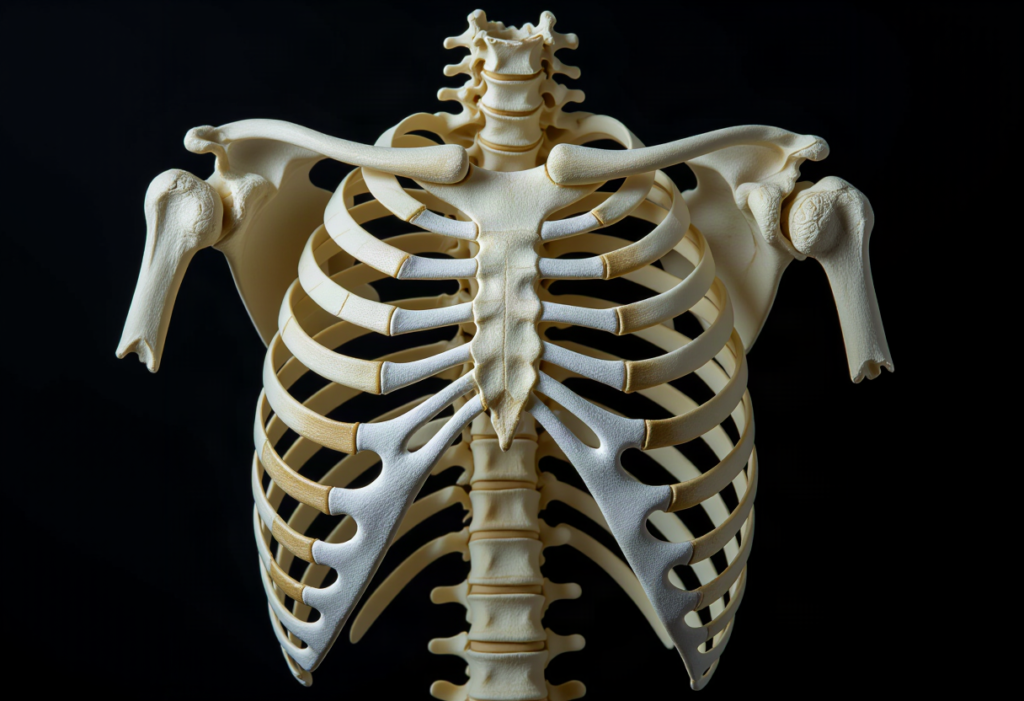
The phrase that draws attention here is fa-kasawna al-‘izama lahman—”We clothed the bones with flesh.” The Arabic verb kasawna carries the sense of dressing or garmenting something already present. The image is not of flesh and bone forming simultaneously, but of a skeletal framework that is subsequently invested or covered by muscle. This article examines whether that description aligns with what developmental biology has established about the sequence of skeletal and muscular formation, and where the comparison is strong, loose, or simply beyond what the text can bear.
What Modern Science Says
The story of a limb begins long before bone appears. Around the fourth week of gestation (Carnegie stages 12–13), lateral plate mesoderm and somitic cells migrate into the limb bud, forming a mesenchymal core beneath a rim of ectoderm—the apical ectodermal ridge, identified by John Saunders in 1948 as a key signalling centre. This mesenchyme is not yet bone and not yet muscle; it is undifferentiated tissue.
What happens next follows a well-documented order. The mesenchymal cells condense and begin chondrification—the formation of a cartilage model—starting in the upper limb around Carnegie stage 16–17 (roughly days 37–41) and slightly later in the lower limb. By Carnegie stage 18–19, the humerus, radius, ulna, and early hand rays exist as cartilage templates. This cartilage model is, in effect, the body’s provisional skeleton.
Ossification follows chondrification. Primary ossification centres appear in the long bones of the limbs between Carnegie stages 18 and 23 (weeks 6–8), when cartilage is progressively replaced by woven bone. Secondary centres in the epiphyses appear much later, often after birth. The famous observation by Friedrich Tiedemann in the early nineteenth century, and later work by Ernest Gardner and others in the twentieth, established that ossification proceeds in a predictable cephalocaudal and proximodistal pattern.
Muscle formation—myogenesis—runs on a parallel but distinct timetable. Myogenic precursor cells from the somites migrate into the limb bud around Carnegie stage 13–14, before the cartilage models are fully defined. However, the assembly of those cells into recognisable muscle masses, and their organisation into distinct muscles that invest the developing skeleton, occurs as the cartilage template is forming and ossifying. By Carnegie stages 17–20, muscle masses are segregating; by stages 21–23, individual muscles are distinguishable and are attaching to the forming bones. The critical point is that the skeletal template is laid down first, and muscle organises around and upon it. Muscle does not precede bone; it wraps, invests, and anchors to a scaffold that is already present, first as cartilage and then as bone.
This sequence is not a matter of interpretation—it is standard embryology, documented in texts such as Langman’s Medical Embryology and the Carnegie Collection’s staging criteria developed by George Streeter in the 1940s and refined by Ronan O’Rahilly and Fabiola Müller.
Where the Two Meet
Set the Quranic phrase beside this timeline and a genuine correspondence emerges. The verse describes bones existing first, then being clothed with flesh. Embryology describes a cartilage model, then ossification, then the investment and organisation of muscle around that skeleton. The Arabic verb’s garmenting imagery—covering something already there—maps naturally onto the way myoblasts aggregate and attach around a pre-existing skeletal scaffold.
It is worth noting that the Quran uses ‘izam (bones), not cartilage. Strictly, the first skeletal framework is cartilaginous, and bone proper appears through ossification. Some readers press this point as a discrepancy; others observe that the Quran is describing the visible structural framework that ultimately becomes bone, and that “bones” is a reasonable everyday term for the developing skeleton. This is an interpretive latitude that should be flagged honestly: the text does not mention cartilage, and it does not describe ossification centres. It states a sequence—skeleton, then flesh—and that sequence is real.
Where the link is looser is in the precise timing. The verse presents the stages as discrete and sequential (“then… then…”), whereas embryology shows overlapping processes: myogenic cells are present in the limb bud before ossification is complete, and muscle and bone development interleave. The Quran’s compressed, rhythmic phrasing is not a staging chart, and it should not be forced into one. The correspondence is at the level of order, not of precise chronology.
Before Its Time
Could a seventh-century text have arrived at this sequence by observation? This is the honest question, and it deserves a careful answer. Miscarriage and dissection were not unknown in the ancient world, and Aristotle and Galen had written on generation—though Galen’s influential view held that the fetus was formed from menstrual blood and that bones and flesh developed together rather than in a strict skeleton-then-muscle order. The notion of a cartilage model preceding bone, and of muscle investing a scaffold, was not part of the common anatomical understanding available in seventh-century Arabia.
That said, claims that the verse contains “modern embryology” in detail overstate the case. The verse does not describe chondrification, Carnegie stages, somites, or myotome migration. It describes a sequence in plain, vivid language. What can be said responsibly is that the sequence it states—skeletal framework first, muscular covering after—is consistent with what developmental biology later established, and that this consistency is noteworthy given the anatomical ideas circulating at the time. Whether one reads that as evidence of divine knowledge or as a fortunate convergence is a matter of conviction, not of scientific proof.
Conclusion
Quran 23:14 presents a sequence: bones, then flesh clothing them. Modern embryology confirms that in the developing limb, a cartilage model is laid down, ossification follows, and muscle organises around and invests the forming skeleton. The match is real at the level of order, and it is fair to say the verse is consonant with the science. It is not fair to say the verse contains the science in technical detail, or that it anticipates Carnegie staging. The most honest position is one of measured appreciation: a seventh-century text describes a sequence that developmental biology, with all its instruments and centuries of accumulation, has confirmed—and the reader is left to reflect on what that consonance means.