
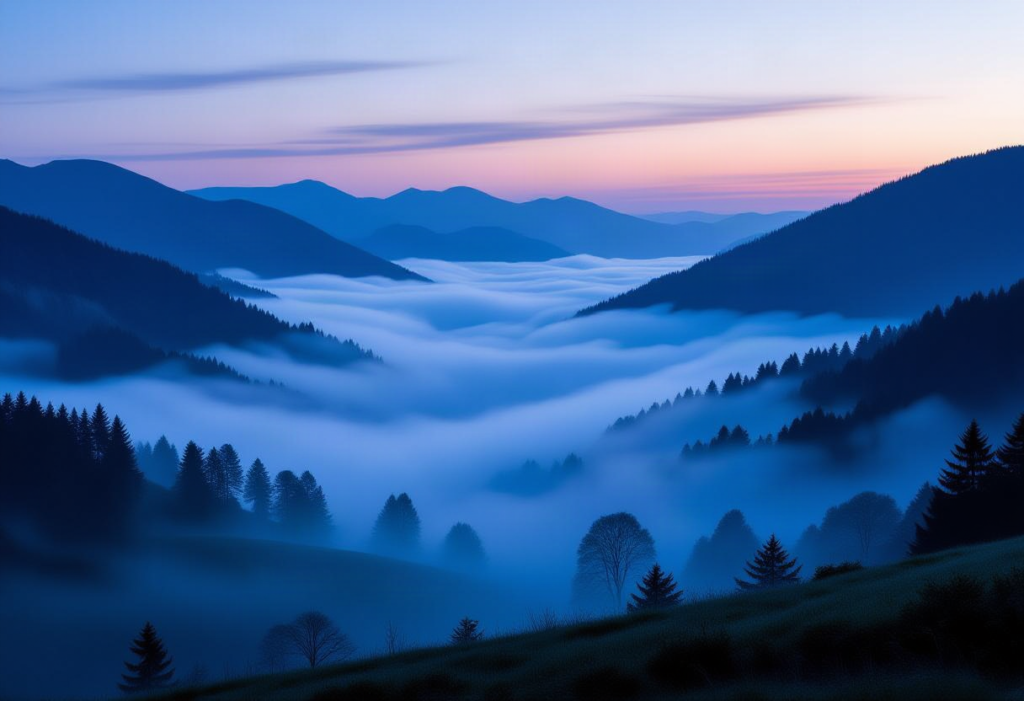

Among the oaths that open Surah al-Takwir, the Quran turns to the sky at its most quiet and most dramatic moments:
“Wa al-layli idha ‘as‘asa. Wa al-subhi idha tanaffasa.”
“By the night as it breathes, and the dawn as it exhales.” (Quran 81:17–18)
The Arabic tanaffasa is usually rendered “breathes” or “exhales,” and the pairing of night and dawn with a single respiratory metaphor is striking. This article asks a modest question: is there anything in modern atmospheric science that illuminates this image? The answer, offered with appropriate caution, is that the structure of the lower atmosphere across the night-to-morning transition bears a genuinely suggestive resemblance to the verse’s imagery.
The Verse
Classical commentators treated these verses as oaths sworn by God on the alternation of darkness and light. The word ‘as‘asa is often glossed as the coming of night or its deepening darkness, while tanaffasa evokes breath, relief, and expansion. The image is not of a static backdrop but of something alive and rhythmic. That poetic choice is what makes a scientific reading worth exploring — not because the Quran is a meteorology textbook, but because the metaphor invites comparison with observed processes.
What Modern Science Says
Atmospheric scientists divide the lowest layer of the atmosphere — the planetary boundary layer, typically the first one to two kilometres — into a daytime convective layer and a nighttime stable layer. The nocturnal boundary layer (NBL) forms when the ground loses heat by longwave radiation after sunset. Air near the surface cools faster than air above it, producing a temperature inversion: temperature rises with height, and vertical mixing is suppressed. The boundary layer effectively “collapses” into a shallow, stratified, quiet state, often only tens to a few hundred metres deep.
Within this stable layer, several distinctive features appear. Winds just above the surface can decouple from surface friction and accelerate into a low-level jet, a phenomenon documented in detail by researchers such as Alfred Blackadar in the 1950s. Turbulence becomes intermittent, driven by wind shear rather than buoyancy. The result is a nocturnal atmosphere that is not inert but slowly, internally active — stratified, pooling, and storing structure until morning.
The morning transition reverses this. After sunrise, solar heating warms the surface, erodes the inversion from below, and eventually triggers convective mixing that can rapidly deepen the boundary layer from tens of metres to over a kilometre within an hour or two. This “breakup” of the inversion is one of the most energetic daily events in the lower atmosphere. It is measured routinely by lidar backscatter, radiosonde balloons, flux towers, and Doppler wind profilers. Foundational work by atmospheric scientists such as Joost Businger, Hans Panofsky, and later boundary-layer researchers established the governing physics through the mid-to-late twentieth century, and modern instruments now resolve the transition hour by hour.
So the scientific picture is this: at night, the lower atmosphere settles into a shallow, stable, radiatively cooled state with suppressed mixing and a low-level jet; at dawn, solar heating breaks the inversion and the atmosphere “opens up” into vigorous convective exchange. The night holds its breath; the morning releases it.
Where the Two Meet
The resonance with Quran 81:17–18 lies in the sequence and the metaphor. The verse pairs night with breathing and dawn with exhalation — a rhythm of containment followed by release. Meteorology describes exactly this rhythm: a nocturnal boundary layer that collapses and stratifies, then a morning transition in which the inversion breaks and mixing resumes on a large scale.
It is worth being precise about what is and is not being claimed. The verse does not mention temperature inversions, low-level jets, or lidar. It uses poetic language about night and dawn. The comparison is therefore one of structural analogy, not technical prediction. Many cultures personify night and morning; what is notable here is how closely the respiratory image maps onto a physical process that was only characterised in the twentieth century.
Before Its Time
Could a seventh-century text have anticipated boundary-layer meteorology? Honest scholarship says we cannot demonstrate that. The nocturnal boundary layer as a quantitative concept emerged from field campaigns and theory in the twentieth century, and the instruments that measure it — lidar, radiosondes, flux towers — are modern. The Quran’s language is evocative and devotional, not technical. Claims that the verse “predicted” the NBL would overreach and would not survive scrutiny.
What can be said is more modest and, arguably, more interesting: the verse captures, in compressed poetic form, a pattern of atmospheric behaviour that science later described in detail. For believers, this can be read as a signature of coherence between revelation and the created order; for sceptics, it is at least a remarkable convergence of imagery and observation. Either way, the comparison is best held with humility.
Conclusion
Modern atmospheric science has given us a precise vocabulary for what happens between sunset and mid-morning: radiative cooling, stable inversion, low-level jet, morning transition, convective mixing. The Quran, fourteen centuries earlier, gave us an image — a night that breathes, a dawn that exhales. The two accounts operate on different registers, and neither should be forced into the other’s mould. Yet when the instruments fall silent and we simply watch the sky, the older image still feels apt: the night draws in and holds, and the morning lets go. Whether one reads that as poetry, providence, or both, the correspondence is worth pausing over — a quiet reminder that observation and reflection have always walked the same dawn.