
To understand the depth of the term “dahaha” (79:30) and its scientific implications, we must look at the intersection of classical Arabic linguistics, the specific geometry of the Earth, and how medieval Islamic scholars used these texts to preempt modern geodesy.
1. The Linguistic Depth of Dahaha (دحاها)
In the Arabic language, roots often carry a physical action and a resulting shape. The root D-H-Y (د ح ي) is particularly nuanced:
- The Action of Spreading: Classically, daha means to thrust, spread out, or expand. However, it specifically describes a circular spreading.
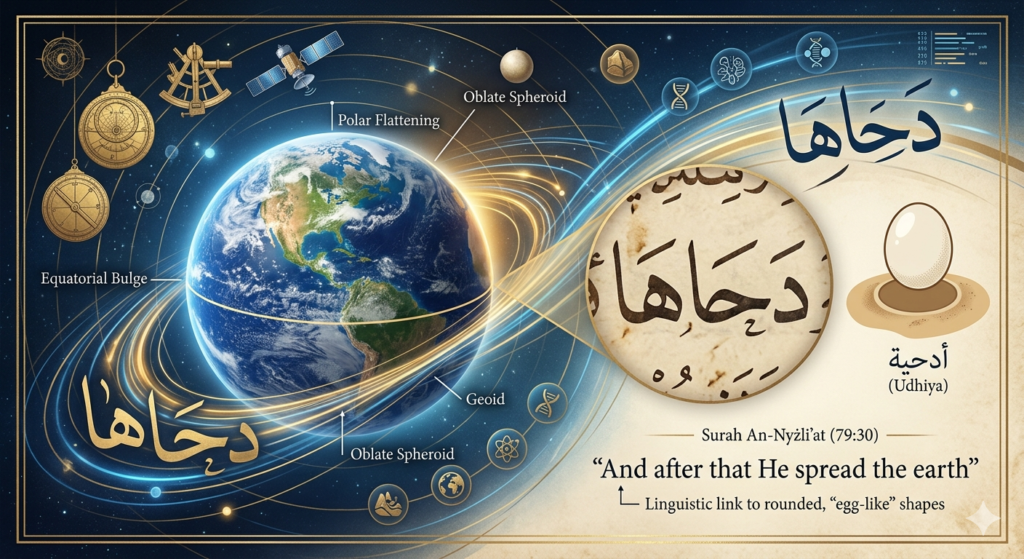
- The Ostrich Connection: The word Udhiya refers to the nest of an ostrich. As noted in the Lisan al-Arab (the most authoritative classical Arabic dictionary), this isn’t just any nest; it is the spot in the sand that the ostrich levels and rounds out with its body and feet to lay its eggs.
- The Prolate Spheroid: An ostrich egg is a prolate spheroid (elongated at the ends). While the Earth is an oblate spheroid (bulged at the center), both are non-perfect spheres. The use of a word rooted in an “egg-shaped” context suggests a surface that is curved and rounded rather than a flat, infinite plane.
2. Scientific Reference: The Earth’s True Shape
Modern science confirms that the Earth is not a perfect sphere. Because of its rotation, centrifugal force causes it to bulge at the equator.
- The Geoid: The Earth is technically an oblate ellipsoid. Its equatorial diameter is about 43 kilometers (27 miles) larger than its polar diameter.
- Scientific Context: This specific “egg-like” deviation from a perfect circle is exactly what the term dahaha implies to modern scholars—a shape that is rounded but “spread out” and slightly irregular.
Reference: For a detailed breakdown of Earth’s dimensions and its ellipsoidal shape, see theNASA Earth Fact Sheet.
3. The “Wrapping” Concept (Scientific Consistency)
To see the full “spherical” picture in the Quran, scholars often pair $79:30$ with Surah Az-Zumar (39:5):
“He wraps (yukawwiru) the night over the day and wraps the day over the night.”
- The Term Yukawwiru: This comes from Kara, meaning “ball” or “sphere.” It is the same word used for winding a turban around a head.
- Scientific Implication: You cannot “wrap” or “coil” a linear phenomenon (like a day/night cycle) unless the surface it is being wrapped around is a sphere. If the Earth were flat, the transition would be a “flip” or a “shutter” effect, not a continuous winding.
4. Historical Context: Early Muslim Scientists
It is a historical fact that medieval Muslim scientists used these verses to argue for a spherical Earth centuries before the age of European exploration.
- Al-Biruni (973–1048 AD): One of the greatest scientists in history, Al-Biruni used trigonometry to calculate the Earth’s radius with incredible accuracy (reaching a value within 1% of modern measurements). He did this while serving the Caliphate, motivated by the Quranic descriptions of the Earth’s vastness.
- Reference: You can read about Al-Biruni’s methodology and his contribution to geodesy via the UNESCO Courier archive on Islamic Science.
- Ibn Hazm (994–1064 AD): In his work Al-Fasl fi al-Milal, he explicitly stated: “The Earth is spherical despite what is commonly believed… the proof is that the Sun is always vertical to a particular spot on Earth.” He argued that the Quranic “spreading” was a description of the Earth’s surface relative to the observer, not its objective shape in space.
5. Why “Spreading” and “Spherical” Coexist
Scientifically, the two concepts are not contradictory; they are a matter of perspective:
- Local Perspective (The “Spread”): To a human standing on the ground, the Earth must be “spread out” (daha) to be habitable. If the curvature were too sharp, gravity and terrain would make life impossible.
- Global Perspective (The “Sphere”): From space, that “spread” surface is curved into a closed loop.
The Quranic choice of dahaha is seen by many as a linguistic miracle because it accommodates both the functional flatness required for human walking and the objective roundness of the planetary body.
Further Reading & Links:
- Geodesy & Earth Shape: NOAA: What is a Geoid?
- Islamic Astronomy: The Metropolitan Museum of Art: Astronomy and Astrology in the Medieval Islamic World
- Linguistic Analysis: For those interested in the Arabic roots, the Project Root List provides a breakdown of the D-H-Y root used in Quran
Read also The Sun Fixed Course and The Sun is Glowing Lamp, but Moon is only Reflect it